
A Global ETF – The Boring Middle
Starting something is exciting. There are so many new things, different things to appreciate and consider, and the learning curve is rewarding enough that you feel like you are progressing nicely.
Then, hitting your end goal or target is exciting. There’s a rush of satisfaction, a sense of completion, and a chance to look back at how far you’ve come. You see the effort paying off, the small wins adding up, the pieces falling into place. It feels earned.
But everything in between? That’s the boring middle.
And that’s where most investors fail – not because they picked the wrong stock or fund, but more often than not, simply because they got bored, distracted, or scared before the real growth had time to happen.
They end up wanting to fiddle around with their investments, tinkering about and end up doing
Investing is about staying consistent in the boring middle. And that’s where wealth is built.
And in this video, I will explain how I personally handle the boring middle, which simple global fund I chose for it and how it all fits in together with my strategy.
In order to organise my investment portfolio strategy I created the Metronome portfolio
Now it’s a fairly complex concept and I made another write up on this portfolio set up that’s worth checking out for a full explanation in the link above.
The Middle of the Metronome Portfolio works in the background. It’s a place for your capital to grow passively and automatically once your dividend Base (covering your Minimum Viable Lifestyle) is established.
This layer is built around a chosen accumulating ETF broad, globally diversified funds that automatically reinvest any dividends.
That means no need for tracking payout dates, no need for decisions about reinvestment, and no need for monitoring company news. You simply buy, hold, and forget.
It’s designed for moments in life when:
- You’re earning well and want to invest surplus cash without the stress.
- You’ve maxed out your Base or tax-advantaged accounts.
- You want to build wealth for the long term (like retirement) without needing to watch the market.
Think of it as a “no-mind” portion of your portfolio: you’re not trying to beat the market, find the perfect stock, or respond to headlines. With the Middle, your job is simple—just invest regularly and leave it alone. The market, time and compounding do the rest.
And it’s flexible too: if your life changes and your income needs rise, you can reallocate funds from the Middle to the Base to increase your dividend income. It’s your overflow tank, your retirement reservoir, and your mental bandwidth protector—all in one.
In short: the Middle exists so your money can keep working, even when your main focus and attention is elsewhere. That’s the real power of no-mind investing.
In order to truly hit that no-mind status you need a reliable ETF.
If you’re completely new to this, don’t worry. An ETF, or Exchange Traded Fund, is just a basket of investments, usually stocks, that you can buy or sell like a single share on a stock exchange.
Let’s break it down without the financial jargon.
ETF stands for Exchange-Traded Fund. At its simplest, an ETF is like a basket of investments—usually made up of stocks, but sometimes bonds or other assets too. You buy shares of this basket just like you’d buy a regular stock on a stock exchange.
But here’s the major point: instead of owning just one company (like buying a share of Tesla or Tesco), when you buy one share of an ETF, you’re getting tiny pieces of hundreds or even thousands of companies, all bundled into that one fund.
That gives you an instant form diversification. If one company in the ETF does poorly, the others can help balance it out. This is a big part of why ETFs are so popular with long-term, hands-off investors, they’re built to spread risk while still capturing growth.
Now, most ETFs don’t try to beat the market. They simply track it. For example:
An S&P 500 ETF holds shares in the 500 biggest companies in the U.S.
A Global ETF might hold companies from dozens of countries, including both developed economies (like the U.S., UK, Japan) and emerging ones (like India or Brazil).
There are ETFs for specific sectors (tech, energy), regions (Europe, Asia), or strategies (dividends, ESG, etc.).
In my case, for the Middle of the Metronome Portfolio, I specifically choose an accumulating global ETF.
Why?
Because:
It automatically reinvests dividends back into the fund, so there’s nothing for me to do.
It covers developed and emerging markets—so I’m not betting on one country or region.
It’s passive, so fees are low.
It works completely in the background while I focus on the other parts of the metronome and let compounding do the work.
ETFs are traded on regular stock exchanges, which means they’re liquid (you can buy or sell easily), transparent (you can see exactly what’s in them), and easy to access through platforms like Trading 212 or others.
So to sum up: ETFs let you own a lot of the market, with very little effort. They’re simple, efficient, and ideal for the long-term, no-mind strategy I use for the “boring middle” of my portfolio.
Here are the criteria I think are important for choosing such an ETF:
- Global diversification (developed and emerging markets)
- Low Total Expense Ratio (what’s known as TER)
- Accumulating dividend policy (Acc)
- Physical replication (not synthetic)
- Large fund size and high liquidity
- Tax efficiency where possible
- Trades in GBP to avoid FX transaction fees
Meeting all these criteria results in a globally diversified, low-maintenance investment vehicle designed for long-term growth. It compounds returns in the background, requiring no active management or rebalancing, while offering broad market exposure and simplicity. It’s ideal for investors who want peace of mind and steady progress without constant oversight.
For me the ETF or fund I chose for this, that I believe satisfactorily fits the criteria, is the Invesco FTSE All-World UCITS ETF Accumulating version with the ticker symbol (FWRG).
And for convenience, as that name is a bit of a mouthful and might be difficult to search and I know that there would be questions about it… I made a pie with this fund inside it as the only component. This means that you can find it much easier on Trading 212 if you are following my public profile on there.
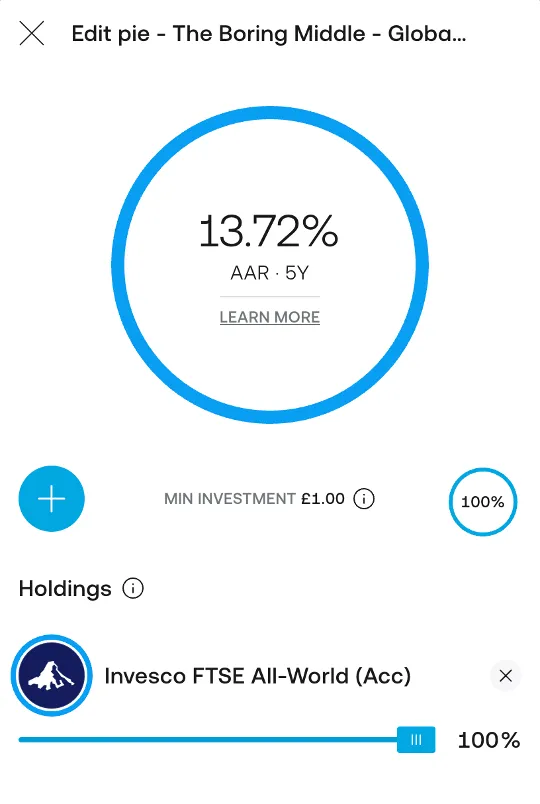
You don’t need to copy it or even hold it in a pie really; I just made it so that its easier for you to find. As it’s an accumulating ETF there is not even the benefit of having dividends reinvested within the pie so copying it is fairly redundant but welcome to if you prefer for whatever reason.
I will link to the pie with the ETF directly here.
And speaking of Trading 212,
If this is the first time you are coming across this pie then the chances are you are new to Trading 212, and in that case you don’t want to miss out on the sign-up offer for new users if you haven’t got it already.

New to Trading 212?
Our promo code gets you a free fractional share. Just make sure you use it within your first 10 days.
Check out our Trading 212 Promo Code
*Capital at Risk. Sponsored content. Terms apply.
I would also like to say that I will explain why I chose this ETF in the rest of this post but want to make the point that it’s not a recommendation or advice for you, personally. You might agree with my thoughts, or you might want to alter them slightly once you see my reasoning.
Let’s take a look…
1. Geographical Coverage
Why It Matters
Diversification is a fundamental principle of investing, helping to reduce risk by spreading exposure across different regions. A true global ETF should cover both developed and emerging markets to capture broad economic growth while mitigating localized downturns.
Comparison of Global Indexes
| Index | Developed Markets | Emerging Markets | Number of Countries |
| MSCI World | Yes | No | 23 |
| MSCI ACWI | Yes | Yes | 49 |
| FTSE All-World | Yes | Yes | 48 |
The FTSE All-World Index, in this case tracked by FWRG, includes a wide range of large and mid-cap stocks from approximately 50 countries. This means investors gain exposure to high-growth markets like China, India, and Brazil, which might be excluded in other ETFs focusing solely on developed economies.
Emerging markets often experience higher growth rates than developed ones. By investing in FWRG, you tap into future growth drivers, ensuring your retirement investments benefit from global economic expansion.