
Updated 30 October 2026
Knowing how to deposit on Trading 212 sounds trivial: you’ve got £500 ready and just need to move it in by bank transfer, debit card, Apple Pay or Google Pay. But the method you choose changes three things at once: how quickly the money lands, how much you can move in one go, and whether you pay anything to do it.
Most of the confusion comes down to a single detail. Bank transfers are free with no limit, while card and wallet deposits share one free allowance and then start carrying a fee. Get those the wrong way round and a large card deposit can cost you real money. Here is each method, what it actually does, and when to reach for it.

Key Takeaways
- Bank transfer is free with no upper limit, but a standard transfer can take up to three business days.
- Instant bank transfer (Open Banking) is also free and arrives in seconds, started from inside the app.
- Card, Apple Pay and Google Pay are instant but share one free allowance of £2,000 in total, then a 0.7% fee applies.
- Deposits must come from an account in your own name; third-party payments are rejected for compliance reasons.
The Short Answer
Trading 212 supports bank transfer, instant bank transfer, debit cards, Apple Pay and Google Pay.
Bank transfers are completely free with no upper limit. However, a standard transfer can take up to three business days.
Card and wallet deposits are instant, but they share a free allowance. Once you have deposited £2,000 across those methods, a 0.7% fee applies.
For someone depositing a few hundred pounds each month, bank transfers keep every deposit free. By contrast, card deposits eventually start costing money.
If you need cash in your account within minutes, several options are available. An instant bank transfer, card, or Apple Pay can get you there.
Funding is only half the picture; our guide on how to use Trading 212 covers what to do once the money has landed.
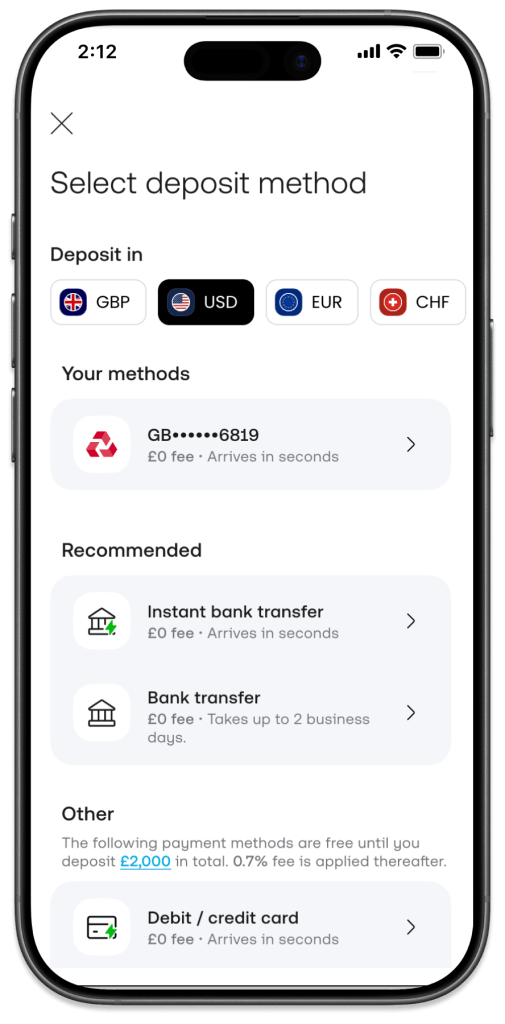
| Method | Speed | Fee and limit |
| Bank transfer | Up to 3 business days | Free, no limit |
| Instant bank transfer (Open Banking) | Seconds | Free, no limit |
| Debit card | Instant | Free up to £2,000 lifetime total, then 0.7% |
| Apple Pay / Google Pay | Instant | Shares the same £2,000 free pool, then 0.7% |
Bank Transfer
For most people this should be the default, because it is free, has no upper limit, and is therefore the only sensible choice for larger amounts.
The minimum is £1, so there is no barrier to starting small.
The thing to plan around is speed: a standard bank transfer can take up to three business days, which is exactly how the app labels it, so if you invest on a set day each month, start the transfer a few days earlier so the cash is sitting ready.
Two details catch people out.
First, the payment has to come from a bank account in your own name; a transfer from a partner’s or parent’s account is rejected for anti-money-laundering reasons, and you would have to reclaim it.
Second, you must include the reference Trading 212 gives you, which is your account number.
Leave it off and the deposit cannot be matched automatically, so instead of arriving in a day or two it sits unallocated until support links it by hand.
If you want it to run without thinking, you can set up a standing order from your bank using Trading 212’s details.
Instant Bank Transfer (Open Banking)
There is a faster version called Instant Bank Transfer, powered by Open Banking, and it removes the main drawback of a standard transfer without adding a cost.
You start it inside the Trading 212 app, get redirected to your own banking app to approve the payment, and the money arrives in seconds. In the app it is listed as “£0 fee, arrives in seconds”.
So you get card-like speed at bank-transfer price.
The one rule that trips people up is that each instant transfer has to be started from within the Trading 212 app, every time, because that is what creates the secure one-time authorisation behind it. If you try to repeat the same payment from your own banking app instead, it is treated as an ordinary transfer and reverts to the up-to-three-day timeline, so you lose the speed without realising why.
Using this option comes down to whether your bank is supported is set by Trading 212’s Open Banking provider. If you use a major UK bank, it almost certainly is.
Where it is available, this is usually the method to reach for.
Debit Cards
Card deposits are about as fast as it gets: you enter the amount, confirm, and the cash is in your account within seconds, with the same £1 minimum.
The part most people get wrong is the free allowance.
Trading 212 lets you deposit up to £2,000 by card for free, but that £2,000 is a cumulative lifetime total across your whole account, not a per-transaction limit, and it does not reset.
Once you have put in £2,000 by card in total, a 0.7% fee applies to every card deposit after that.
It is clearer with an example:
If you have never used card deposits and you pay in £5,000 at once, the first £2,000 is free and the remaining £3,000 is charged at 0.7%, which is about £21.
After the allowance is used up, a later £1,000 card top-up costs about £7.
You can see exactly how much of the free allowance is left on the Deposit Funds screen.
One more practical point: some bank cards block payments to investment platforms, so if a deposit is declined, it may actually be your bank flagging it rather than a problem on the Trading 212 side. A quick call to your bank usually clears it.
Apple Pay and Google Pay
Apple Pay and Google Pay behave just like card deposits, instant, £1 minimum, using the card linked to your phone, with the convenience of Face ID or a fingerprint instead of typing in card details.
The point that matters for your costs is that they do not get their own allowance.
They draw on the same combined £2,000 free pool as your debit card, not a separate one.
So if you have already used £1,500 of card deposits, you have only £500 of free wallet deposits left before the 0.7% fee starts, whether you tap a card or your phone.
The practical rule is to treat cards and wallets as a single shared bucket when you decide how to fund the account, and to keep an eye on how much of the £2,000 you have used if you rely on instant methods.
Which Method Should You Use?
For regular monthly investing, use a bank transfer. An instant bank transfer is even better if your bank supports it.
It is free regardless of the amount. A standing order can also automate the process, so the money is there when you want to invest.
For a large lump sum, always use bank transfer.
There is no limit and no fee, whereas a single big card deposit could push you over the free allowance and cost 0.7% on the excess, so a day or two of patience can save you twenty or thirty pounds.
Keep cards and wallets for when you need the money to land immediately.
If you are funding from a foreign currency, you can deposit directly in that currency on a multi-currency Invest account and avoid converting it twice, which our guide to the multicurrency account explains. And because Trading 212 generally returns withdrawals to the method you deposited with, it is worth knowing how the money comes out too, see our guide on how to withdraw from Trading 212.
None of this affects the platform’s own charges, which we cover in our guide to Trading 212 fees.
Conclusion
The conclusion for how to deposit on trading 212 is pretty simple: use bank transfers for regular or larger deposits. Use instant bank transfers when you want speed without fees.
Use cards or digital wallets only when timing is important to you. The key thing to remember is that the free card and wallet allowance is cumulative.
It is a single £2,000 limit, not a fresh allowance each time. Once it is used up, instant deposits cost 0.7%.
Match the payment method to the situation, and your deposits stay free.
FAQ
How long does a Trading 212 deposit take?
Bank transfers can take up to three business days. Instant bank transfer, debit cards, Apple Pay and Google Pay are usually instant.
Is there a fee to deposit on Trading 212?
Bank transfers are always free. Card and wallet deposits are free up to a combined £2,000 lifetime total, after which a 0.7% fee applies.
Can someone else deposit money into my account?
No. Deposits must come from a bank account or card in your own name. Third-party payments are rejected for anti-money-laundering reasons.
What is the minimum deposit on Trading 212?
The minimum is £1 across bank transfer, card, Apple Pay and Google Pay.