
Updated 23 October 2026
You can get copper exposure in minutes on Trading 212 without buying or storing the physical metal. Instead, you invest in a product that follows the copper price and trades as easily as a single share. This guide shows exactly how to buy copper on Trading 212, the main products to consider, why the futures market can sometimes work in investors’ favour, and how to place your order.
Copper is widely seen as the metal of the future, with demand driven by electric vehicles, renewable energy and AI data centres while new supply struggles to keep pace. In this short guide, we also compare copper-price investments with copper mining shares, so you can choose the exposure that best suits your goals.

Key Takeaways
- There is no practical physical copper ETC; products track the price using futures contracts.
- Copper futures are often in backwardation, so the roll can work in your favour, unlike oil or gas.
- The main product is WisdomTree Copper, listed as COPA (USD) and COPB (GBP), around 0.49% a year.
- UK investors can use COPB to avoid the 0.15% currency fee.
- Be wary of leveraged products such as 3HCL as they come with greater risks.
What You Are Actually Buying
Unlike gold, silver, platinum, and palladium, there is no widely available physical copper ETC backed by metal held in a vault.
Copper’s low value-to-weight ratio makes physical storage completely uneconomical. A single ounce of gold worth $3,000 is tiny, but the same value of copper would weigh roughly 300 kilograms at time of writing.
Instead, on Trading 212 you buy an ETC, or Exchange Traded Commodity, that uses futures contracts to track the copper price. It works in much the same way as oil and natural gas ETCs.
Copper is one of many raw materials you can access this way, and our guide on how to buy commodities covers the full range.
How Do Copper ETCs Work?
Copper ETCs use a synthetic, futures-based approach. The provider buys copper futures, which are agreements to buy copper at a future date for a set price. As those contracts approach expiry, they are rolled into new ones, so the ETC tracks the copper price through derivatives rather than physical metal.
The good news is that copper’s futures curve is often in backwardation, the opposite of contango. That means near-term contracts trade at higher prices than later ones.
When that happens, the roll can add a small boost to your return. This is very different from many oil or gas products.
It is not guaranteed, though. During periods of surplus supply, copper can move into contango instead. When that happens, the roll can work against you, so it is worth keeping an eye on the futures curve.
ETCs vs Mining Stocks: Which Is Better?
Copper price ETCs are designed to track the spot copper price through futures. Products like WisdomTree Copper (COPA) aim to follow the Bloomberg Copper SubIndex, so if copper rises, your ETC should broadly rise too.
It is the most direct exposure for investors with a view on the copper price itself. Copper mining companies are a different game. Names like Antofagasta (ANTO), Glencore (GLEN), Rio Tinto (RIO), BHP (BHP) or Freeport-McMoRan (FCX) can rise with copper but behave like a leveraged bet.
If it costs $3.00 per pound to mine and copper sells for $4.50, that is $1.50 profit; an 11% rise to $5.00 lifts profit to $2.00, a 33% jump. It works both ways, with extra risks from regulation in mining jurisdictions such as Chile, Peru or the DRC that can crash a share even when copper is at highs.
Things to Watch Out For
Remember the exposure is futures-based. Copper’s roll yield is often favourable thanks to backwardation, but nothing guarantees it, and it can turn negative in a surplus, so keep an eye on the futures curve.
On costs, Trading 212 charges a 0.15% currency conversion fee, and copper is priced in US dollars, so a pound account pays it on the buy and the sell unless you use the GBP version of the ETCs.
WisdomTree lists a GBP version, COPB, that sidesteps the fee, and the ongoing charge (expense ratio) is around 0.49%.
The ETC Questionnaire
There is also one quick step to know about before your first purchase. Because ETCs are classed as complex products, Trading 212 may ask you to complete a short appropriateness questionnaire before you can buy one. Our guide to the Trading 212 ETC questionnaire explains exactly what it asks and how to complete it.
How to Buy Copper on Trading 212: Step by Step
Step 1: The Search
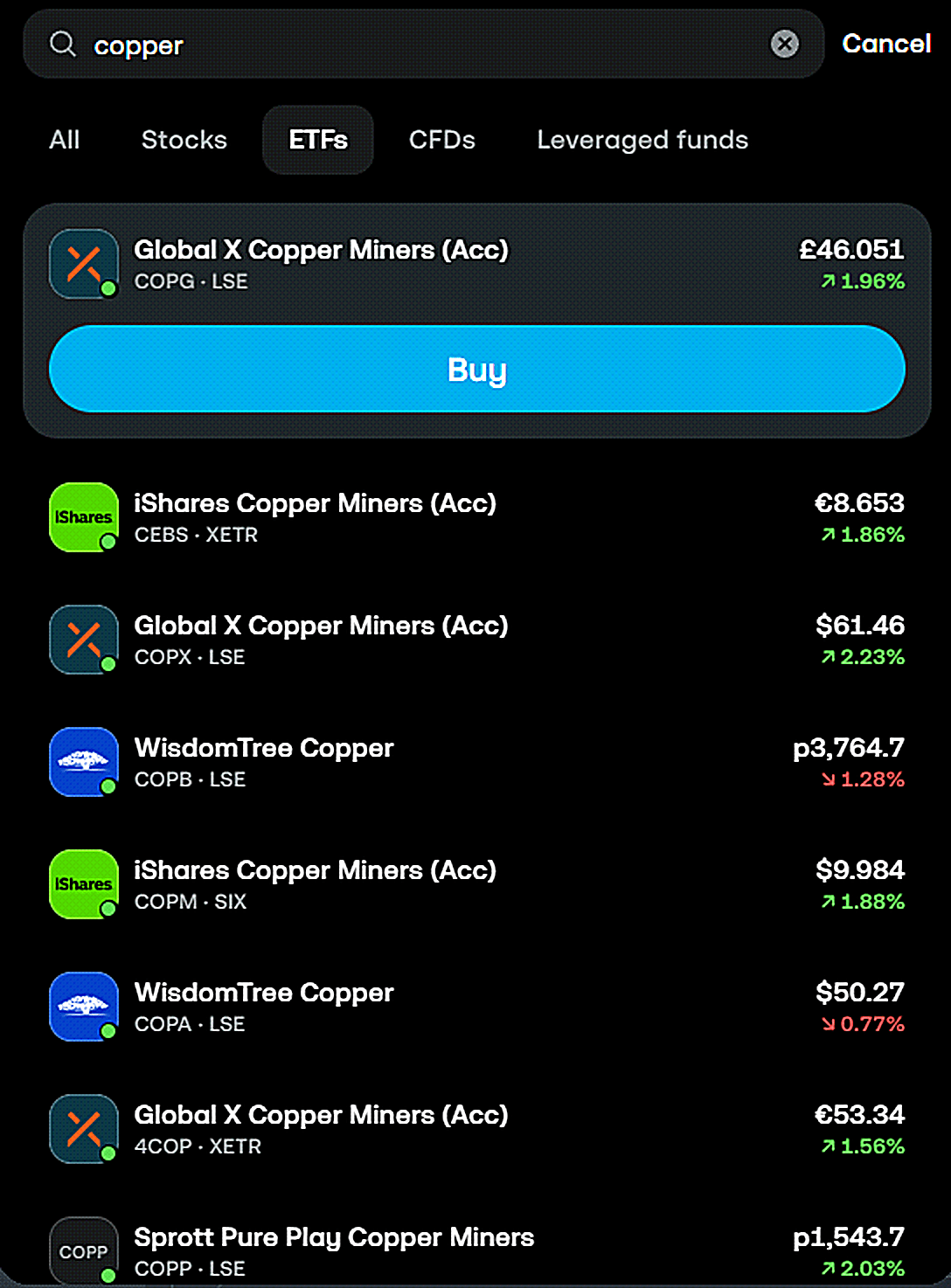
Open the search, the magnifying glass icon, and type Copper. Some results are leveraged, such as WisdomTree Copper 3x Leveraged (3HCL), which amplify daily moves and are not suited to tracking the actual copper price. Filter to the ETFs section for the standard trackers.
Step 2: Choosing Your Product
The main standard is WisdomTree Copper, available in two lines that share the same underlying exposure.
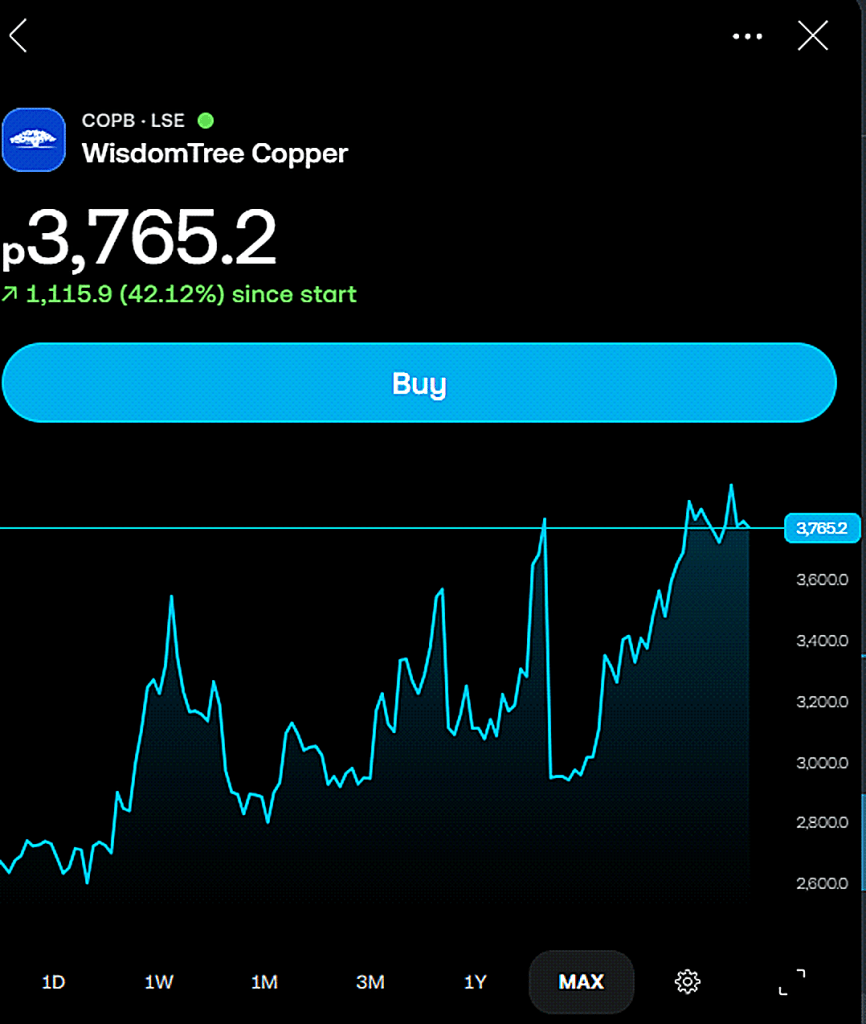
COPA is the USD line, the most liquid version, while COPB is the GBP line that helps UK investors avoid the currency fee. Both track the Bloomberg Copper SubIndex with an ongoing charge around 0.49%.
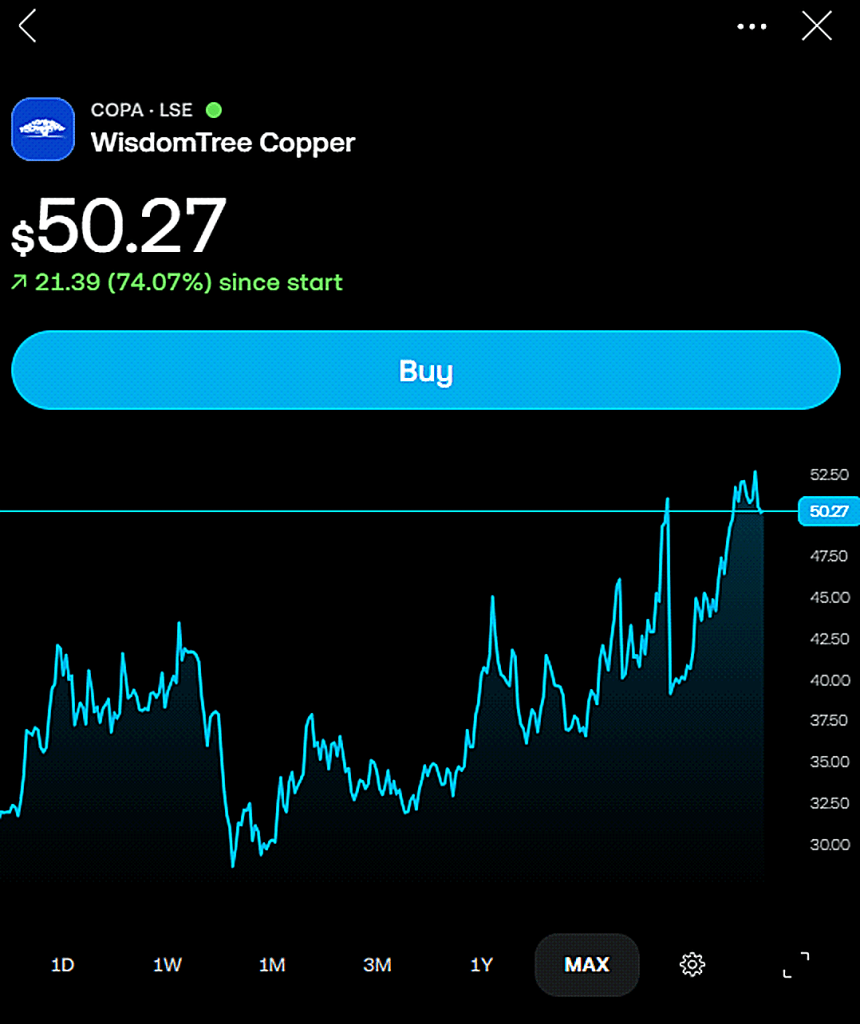
Choose COPA if you are comfortable with dollar exposure or want maximum liquidity, or COPB to keep things simple in pounds.
Step 3: Checking the Details
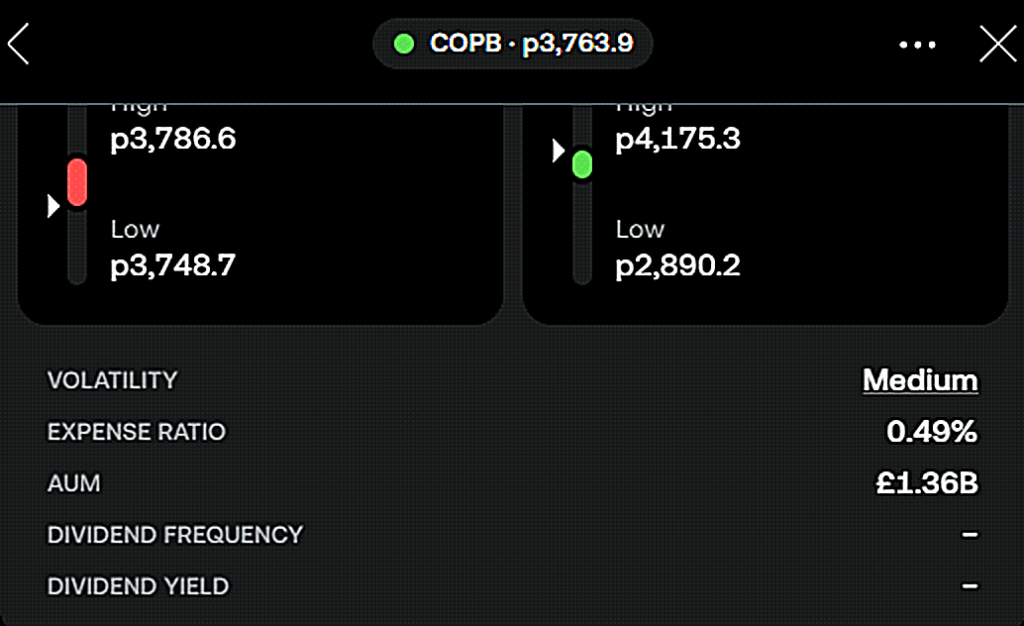
Click into the product and scroll to Instrument Details. Expect an ongoing charge around 0.49%, shown as the expense ratio.
Then check the currency and confirm whether it says USD, which is COPA, or GBP/GBX, which is COPB.
Step 4: Market vs Limit Orders
When you press buy you have a choice in the top right.
A market order buys instantly at the current price, which is convenient but can slip if the price moves while it processes.
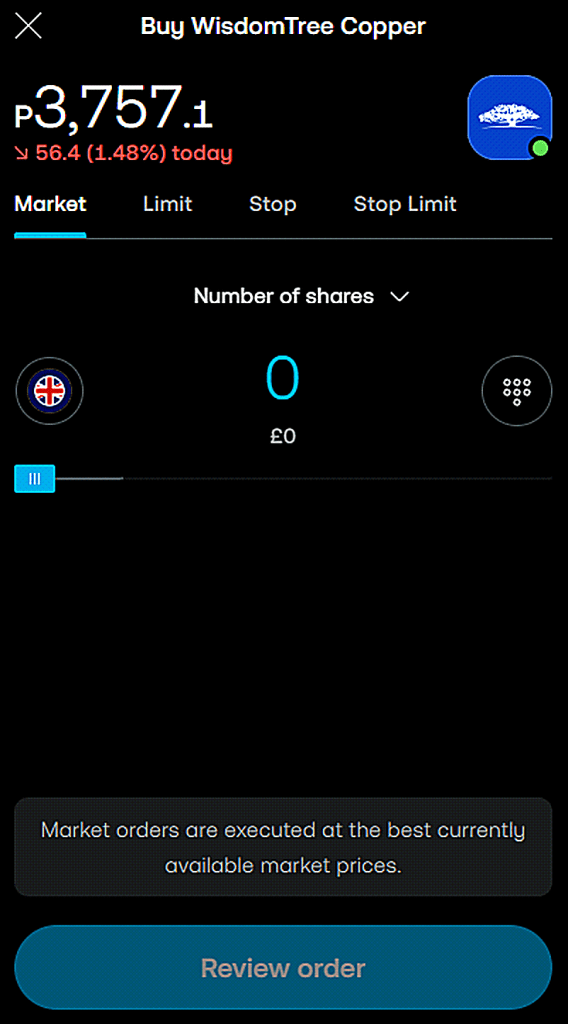
A limit order lets you set the exact maximum you will pay; if the ETC trades at 3,757.1p you might set a limit at 3750p, and it only fills if the price dips to your level.
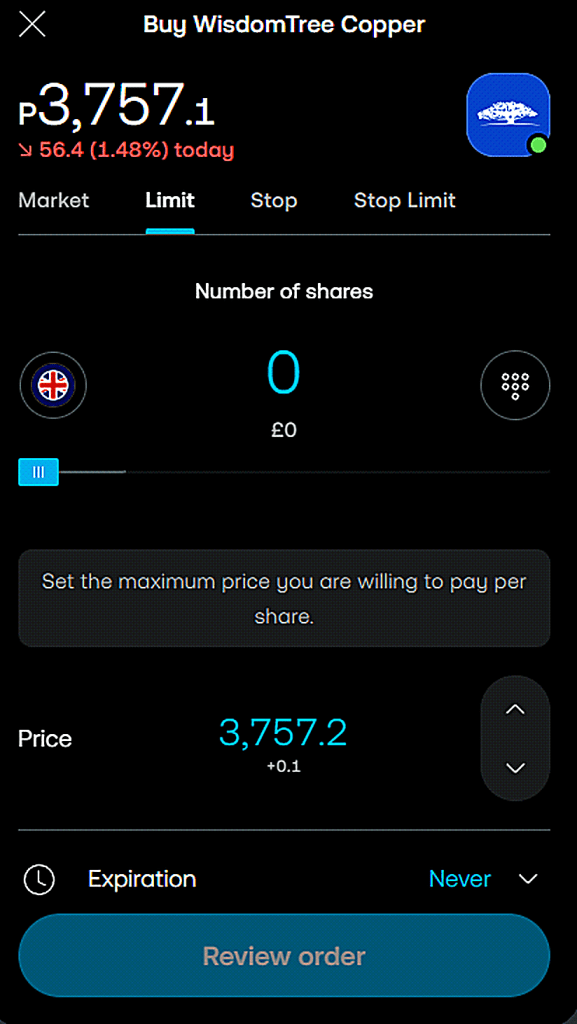
Market and limit orders are just the starting point. Trading 212 also offers stop orders, stop-limit orders, and other tools that can help you buy at a specific price or protect against sudden drops. For a full breakdown of how each order type works and when to use them, see our guide on Trading 212 order types.
Conclusion
For most people, a copper ETC such as COPA or COPB is the simplest way to track the copper price on Trading 212, and unlike oil and gas it often benefits from a helpful roll yield rather than a drag.
UK investors can avoid the currency fee by using the GBP line, COPB. Copper mining shares are a higher-risk alternative, but the ETC gives cleaner, more direct exposure to the price.
FAQ
Can I Buy Physical Copper on Trading 212?
Not practically. Copper’s low value-to-weight ratio makes a physical ETC uneconomical so you can buy an ETC that tracks the price using futures instead to get exposure to the copper price.
Is Copper Affected by Contango Like Oil?
Less so. Copper futures are often in backwardation, where the roll can add a small bonus. Though, this can reverse to contango in a market surplus.
COPA or COPB?
They are the same WisdomTree exposure in different currencies. COPB trades in pounds and avoids the 0.15% currency fee for UK investors, while COPA trades in dollars and is the most liquid line.
Can I Hold Copper in an ISA?
Yes. Copper ETCs can be held in a Stocks and Shares ISA, so any gains are tax-free. (Tax treatment depends on your individual circumstances and regulations which may change.)