
Updated 31 July 2026
You can get oil exposure in minutes on Trading 212 without buying physical barrels of crude. Instead, you invest in a product that follows the oil price and trades as easily as a single share. This guide shows exactly how to buy oil on Trading 212, the main products to consider, the hidden costs to watch for, and how to place your order.
Crude oil is one of the world’s most actively traded commodities, with geopolitics, OPEC+ decisions and the global energy transition driving constant price swings. We also compare oil-price investments with oil company shares, so you can choose the exposure that best suits your investment goals.

Key Takeaways
- There is no physical oil ETC; oil products track the price using futures contracts.
- Because of futures, oil ETCs suffer from contango, which can erode returns over time.
- The main trackers are WisdomTree Brent Crude Oil (BRNG) and WisdomTree WTI Crude Oil (CRUP).
- UK investors can use a GBP-hedged line such as PBRT to cut the 0.15% currency fee and currency risk.
- Oil ETCs suit shorter-term tactical trades better than buy-and-hold.
What You Are Actually Buying (Digital vs Physical)
First, let us clear up a common misconception. When people say they are buying oil on Trading 212, they do not mean a barrel of Brent crude arriving at their doorstep.
Buying physical crude oil is not practical for individual investors. It requires specialist infrastructure to transport and store the oil safely, as well as access to the wholesale commodities market.
Unlike gold or silver, there is no widely available investment backed by physical barrels of oil. Crude oil is a consumable commodity that is costly to store, deteriorates over time and requires specialised handling, making it impractical for an investment product to hold it in the way a gold ETC holds bullion.
So what are you actually buying?
Instead of owning physical oil, you buy an investment that aims to follow the price of crude oil. It trades on the stock market just like a share, allowing you to gain exposure without ever taking delivery of a barrel. This type of investment is called an Exchange-Traded Commodity (ETC). Because it cannot hold physical oil, it tracks the price using futures contracts instead.
Oil is one of many raw materials you can access this way, and our guide on how to buy commodities covers the full range.
How Do Oil ETCs Work?
Unlike a physical metal ETC, which stores bars in a secure vault, oil ETCs cannot hold physical barrels of crude. Instead, they follow the oil price using futures contracts.
A futures contract is an agreement to buy oil at a future date for a price agreed today. As each contract approaches its expiry date, the ETC sells it and replaces it with a new one, allowing the investment to maintain continuous exposure to the oil price.
This means the ETC tracks oil through futures rather than by storing physical barrels. Replacing contracts can create an additional cost over time, which is why oil ETCs behave differently from physical gold or silver ETCs.
ETCs vs Oil Company Stocks: Which Is Better?
There are two main ways to get oil exposure, and choosing the wrong one is the first mistake beginners make. Oil price ETCs are designed to track the spot crude price through futures.
Products like WisdomTree Brent Crude Oil (BRNG) and WisdomTree WTI Crude Oil (CRUP) aim to track benchmark oil prices. If oil rises, your ETC should broadly rise too, making these products the most direct choice for investors with a view on the oil price itself.
Oil company shares are different. Companies like Shell (SHEL), BP (BP.), and TotalEnergies (TTE) behave more like a leveraged bet. If it costs a company $50 to extract a barrel of oil and the oil price is at $70, profit is $20.
A 14% rise to $80 lifts profit to $30, a 50% increase from a 14% move.
It works both ways, though. Rising costs, regulatory crackdowns, environmental disasters, or management problems can hurt the share price even when oil reaches multi-year highs.
Things to Watch Out For (Fees, Currency and Contango)
The biggest hidden cost with oil ETCs comes from how they replace their futures contracts over time.
Each time an old contract expires, the ETC has to buy a new one to maintain its exposure.
The problem is that the new contract often costs more than the one it has just sold. Imagine pre-ordering the same product every month, only to find each new pre-order is slightly more expensive than the last. That extra cost gradually eats into your returns, even if the oil price itself does not move very much.
This situation is known as contango, while the reduction in returns caused by repeatedly replacing contracts is often called negative roll yield. Unlike physical gold or silver ETCs, this is a cost unique to futures-based products. Over months and years, these costs can significantly erode returns, which is why oil ETCs are generally better suited to shorter-term trades than long-term buy-and-hold investing.
Trading 212 also charges a 0.15% currency conversion fee if you buy a USD-priced oil ETC with a pound account, and again when you sell.
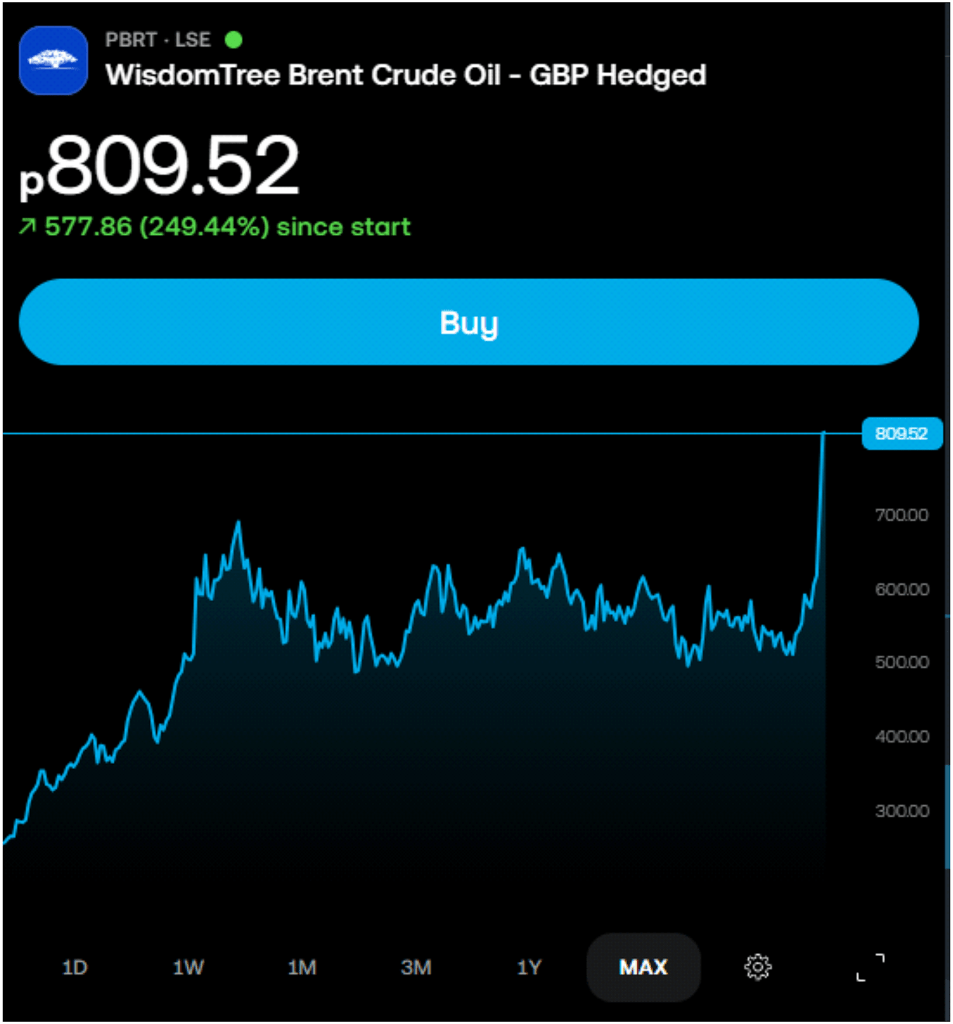
To reduce both the currency risk and the FX fee, UK investors can consider GBP-hedged versions such as PBRT (WisdomTree Brent Crude Oil GBP Hedged), which are priced in pounds rather than US dollars.
The ETC Questionnaire
There is also one quick step to know about before your first purchase. Because ETCs are classed as complex products, Trading 212 may ask you to complete a short appropriateness questionnaire before you can buy one. Our guide to the Trading 212 ETC questionnaire explains exactly what it asks and how to complete it.
How to Buy Oil on Trading 212: Step by Step
Step 1: The Search
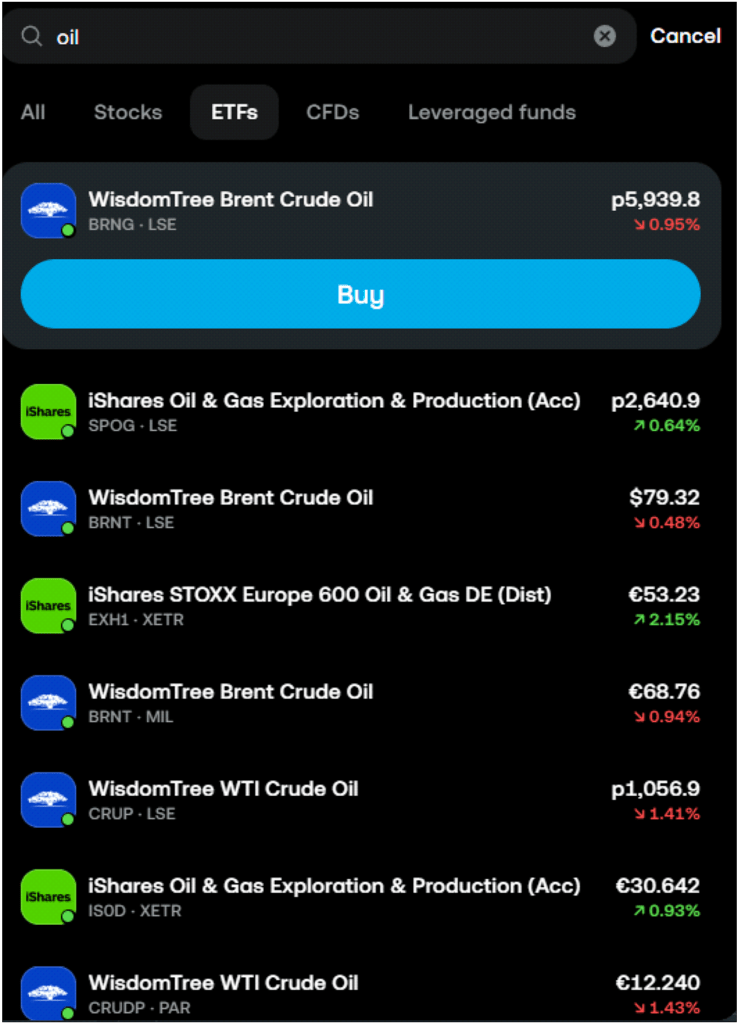
Open the search, the magnifying glass icon, and type Crude Oil or Brent Oil. You will see a long list of results.
Some are leveraged products, complex daily tools that amplify returns and are not suitable for long-term investors tracking the actual oil price, so filter to the ETFs section for the standard trackers.
Step 2: Choosing Your Product
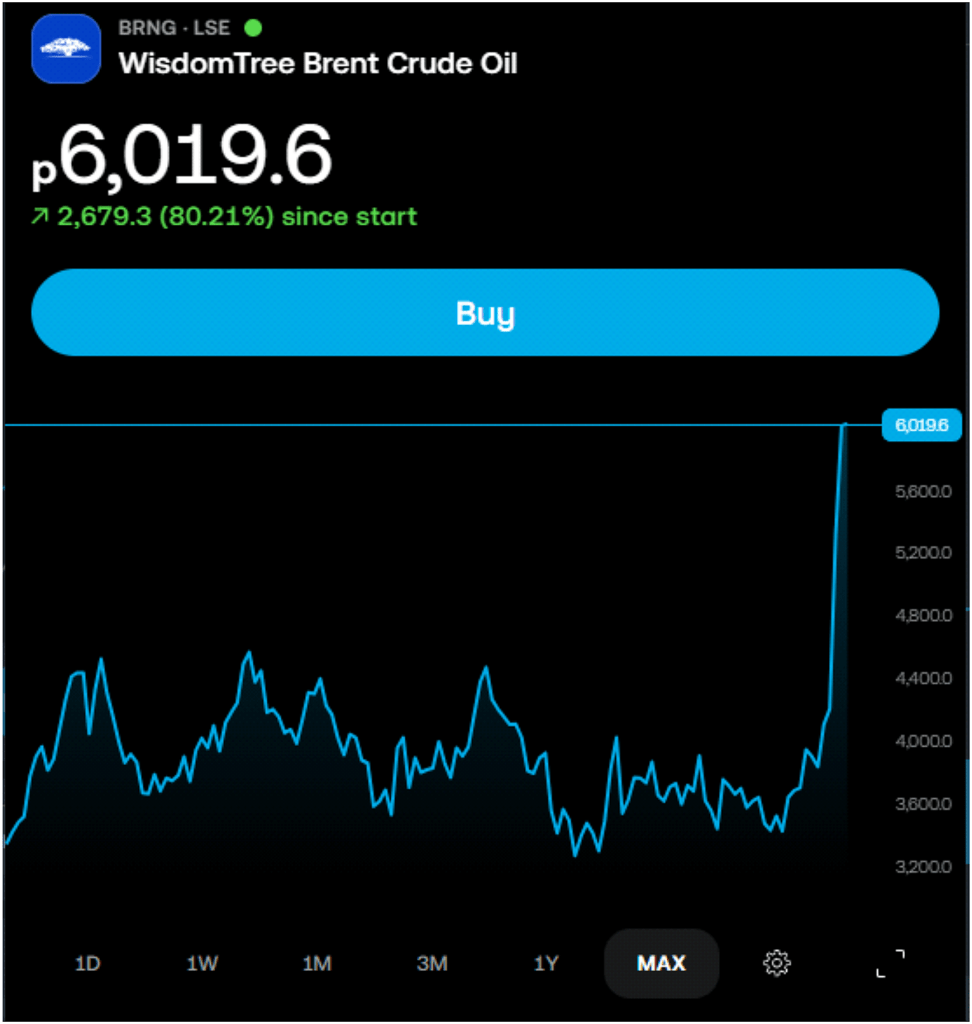
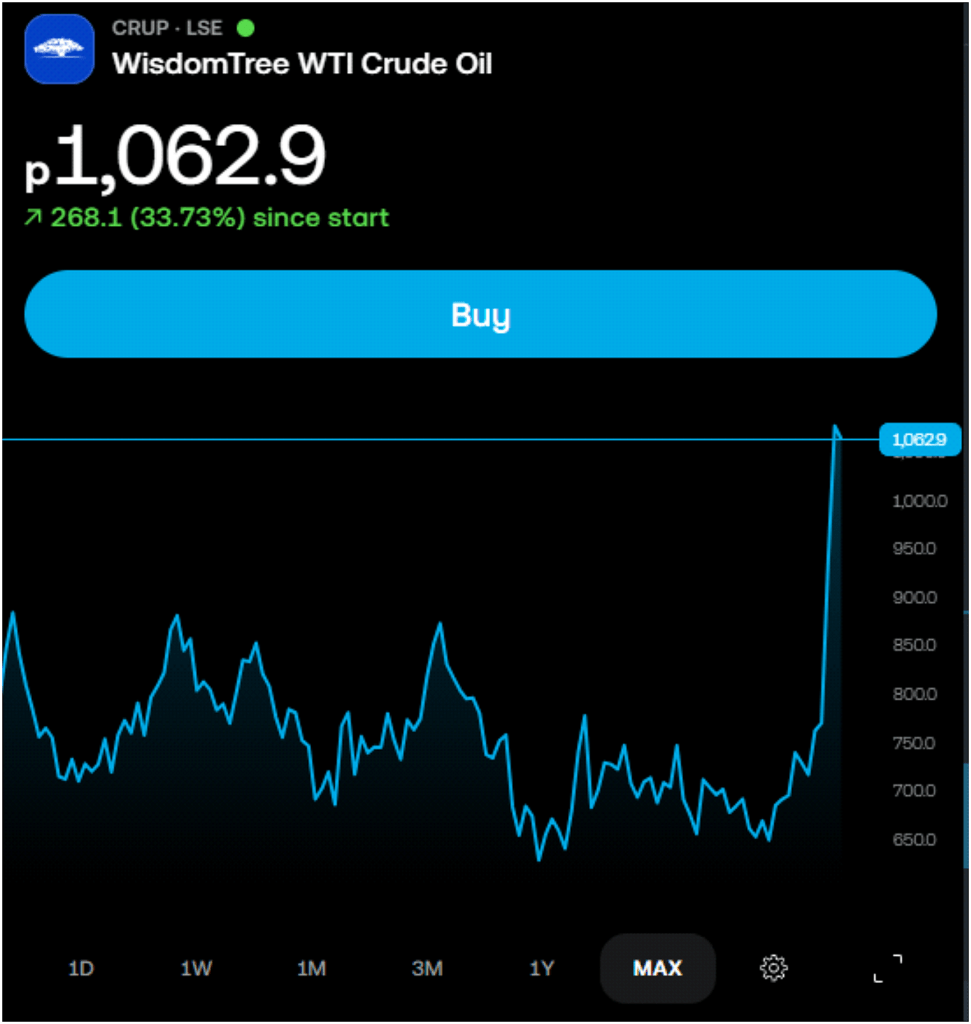
For 2026 the two main standards are WisdomTree Brent Crude Oil (BRNG) and WisdomTree WTI Crude Oil (CRUP).
BRNG tracks Brent crude, the international benchmark behind roughly two-thirds of the world’s oil contracts.
CRUP tracks WTI, the US benchmark, which is more relevant if you are focused on the American energy market.
Either can be a solid choice depending on your outlook, and UK investors who want to avoid the currency fee can look at the GBP-hedged PBRT.
Step 3: Checking the Details
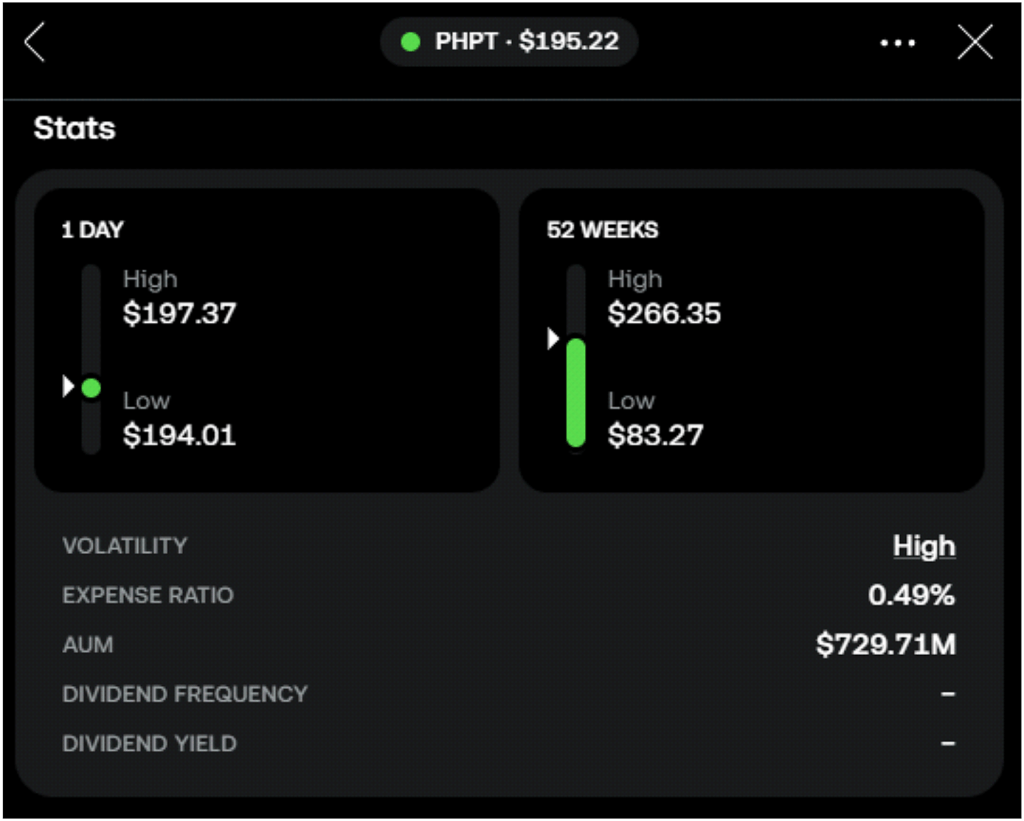
Click into the product and scroll to Instrument Details.
Check the ongoing charge, shown as the expense ratio, and confirm the currency: a GBP or GBX line avoids the conversion fee, while a USD line means you pay it.
Remember that with oil, the contango drag can matter more than the headline fee.
Step 4: Market vs Limit Orders
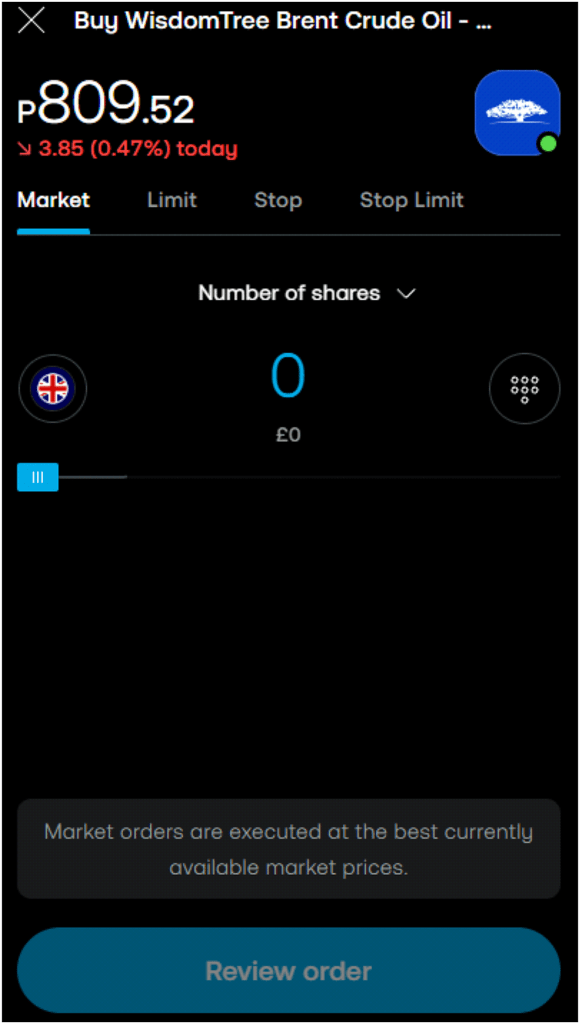
When you press buy you have a choice in the top right.
A market order buys instantly at the current price, which is convenient but can slip if the price moves while it processes.
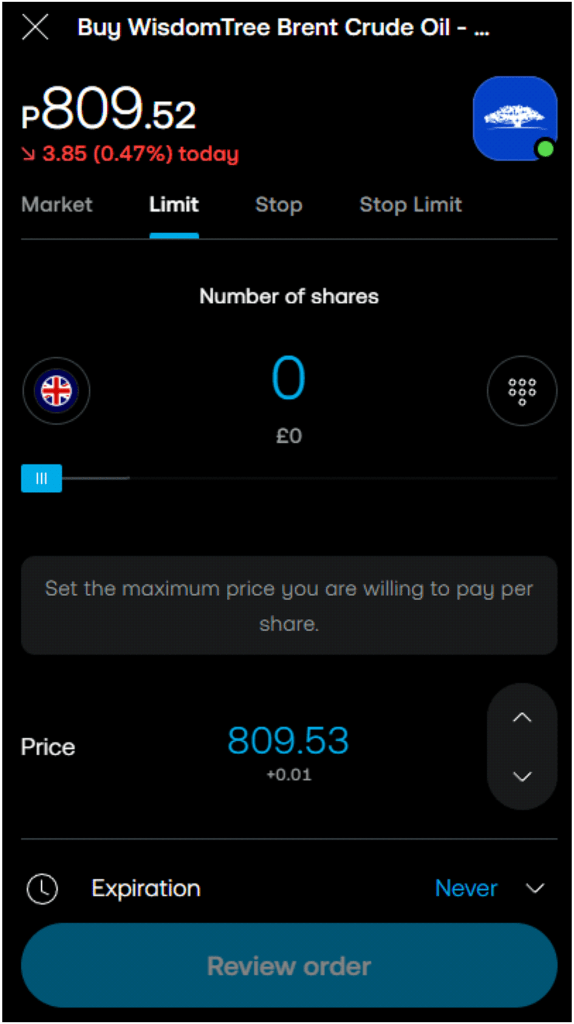
A limit order lets you set the exact maximum you will pay, filling only if the price reaches your level, which gives you more control.
Market and limit orders are just the starting point. Trading 212 also offers stop orders, stop-limit orders, and other tools that can help you buy at a specific price or protect against sudden drops. For a full breakdown of how each order type works and when to use them, see our guide on Trading 212 order types.
Conclusion
For most investors, an oil ETC such as BRNG or CRUP is the simplest way to track oil on Trading 212. Because these ETCs use futures contracts, they are generally better suited to shorter-term positions than long-term buy-and-hold investing.
UK investors can cut the currency fee with a GBP-hedged line like PBRT. Oil company shares are an alternative. However, they are driven by far more than the oil price, so the ETC gives cleaner exposure.
FAQ
Can I Buy Physical Oil on Trading 212?
No. There is no physically backed oil ETC. You buy an ETC that tracks the oil price using futures contracts.
Why Do Oil ETCs Underperform the Oil Price?
Because they roll futures contracts, oil ETCs suffer contango drag when the next contract is dearer than the current one, which erodes returns over time even if spot oil rises.
Can I Hold an Oil ETC in an ISA?
Yes. Oil ETCs can be held in a Stocks and Shares ISA, so any gains are tax-free, though the contango point still applies. (Tax treatment depends on your individual circumstances and regulations which may change.)
BRNG or CRUP – Which Should I Pick?
BRNG tracks Brent, the global benchmark, and CRUP tracks WTI, the US benchmark. Choose the one that matches your market view; both trade in US dollars unless you use a hedged line.