
Updated 31 July 2026
You can get platinum exposure in minutes on Trading 212 without having to buy and store physical bars. Instead, you invest in a product that follows the platinum price and avoids the 20% VAT normally charged on physical platinum in the UK. This guide shows exactly how to buy platinum on Trading 212, the main product to consider, the costs to watch for, and how to place your order.
Platinum has quietly staged a strong recovery after years of demand outstripping supply, with many analysts viewing it as undervalued relative to gold. It also has a demand driver that gold and silver lack: an important role in hydrogen fuel cells alongside its long-standing industrial and automotive uses.

Key Takeaways
- You buy platinum through a physically backed ETC held in a vault, not bars delivered to you.
- ETCs avoid the 20% VAT that physical platinum bars carry in the UK because HMRC treats it as industrial.
- The main product is WisdomTree Physical Platinum (PHPT), with an ongoing charge of around 0.20%.
- Most platinum ETCs are USD-priced, so factor in the 0.15% currency fee or look for a GBP line.
- Platinum has a unique long-term demand driver in hydrogen fuel cells that gold and silver lack.
What You Are Actually Buying (Digital vs Physical)
Buying platinum on Trading 212 does not mean a bar arriving by courier. If you want to own physical platinum, you need to buy it from a specialist bullion dealer. In the UK, physical platinum carries 20% VAT, so part of your investment is lost to tax before the price even has a chance to move.
Like silver and palladium, HMRC treats platinum as an industrial precious metal for VAT purposes, so it doesn’t get the exemption available to investment-grade gold.
So what are you actually buying?
Instead of taking delivery of a platinum bar, you buy an investment that represents professionally stored platinum and trades on the stock market just like a share.
Because the metal remains in a secure vault and never enters the retail supply chain, VAT is not charged, allowing 100% of your investment to start working from day one. This type of investment is called an Exchange-Traded Commodity (ETC). It is physically backed, meaning each ETC is supported by allocated platinum held in secure vaults on behalf of investors.
Platinum is one of many raw materials you can hold this way, and our guide on how to buy commodities covers the full range.
Why Is It an ETC and Not an ETF?
Platinum products are almost always labelled ETCs because of UCITS rules. A fund must be diversified across a basket of assets, and a single-metal tracker does not qualify.
Instead, providers issue them as ETCs. Technically, an ETC is a debt security that is fully backed by physical metal held in a vault. For you as an investor, however, it trades just like a share.
ETCs vs Mining Stocks: Which Is Better?
Physical platinum ETCs track the spot platinum price directly, backed by real bars in institutional vaults, so if platinum rises 1% your holding moves broadly in line. It is the cleanest, most popular exposure for long-term investors.
Platinum mining companies are a different proposition and behave like a leveraged bet on the metal’s price.
The main miners include Anglo American Platinum, Impala Platinum, Sibanye Stillwater, and Northam. Most are listed in South Africa, which produces around 70% of the world’s platinum.
Suppose it costs $900 to mine an ounce of platinum and it sells for $1,100. That leaves a profit of $200 per ounce. If platinum rises 18% to $1,300, that profit doubles to $400.
It cuts both ways. Mining shares also face risks from South African power shortages (load-shedding), strikes, and political instability. Any of these can hurt a company’s share price even when platinum itself is performing well.
Things to Watch Out For (Fees and Currency)
Trading 212 charges a 0.15% currency conversion fee, and platinum is priced in US dollars, so a pound account pays it on the buy and the sell unless you use a GBP-listed variant where one is available.
Always check the currency on the Trading 212 listing before you buy. The ongoing charge, shown as the expense ratio, is around 0.20% for WisdomTree Physical Platinum. That is a little higher than gold or silver, which is normal given the smaller platinum market.
The ETC Questionnaire
There is also one quick step to know about before your first purchase. Because ETCs are classed as complex products, Trading 212 may ask you to complete a short appropriateness questionnaire before you can buy one. Our guide to the Trading 212 ETC questionnaire explains exactly what it asks and how to complete it.
How to Buy Platinum on Trading 212: Step by Step
Step 1: The Search
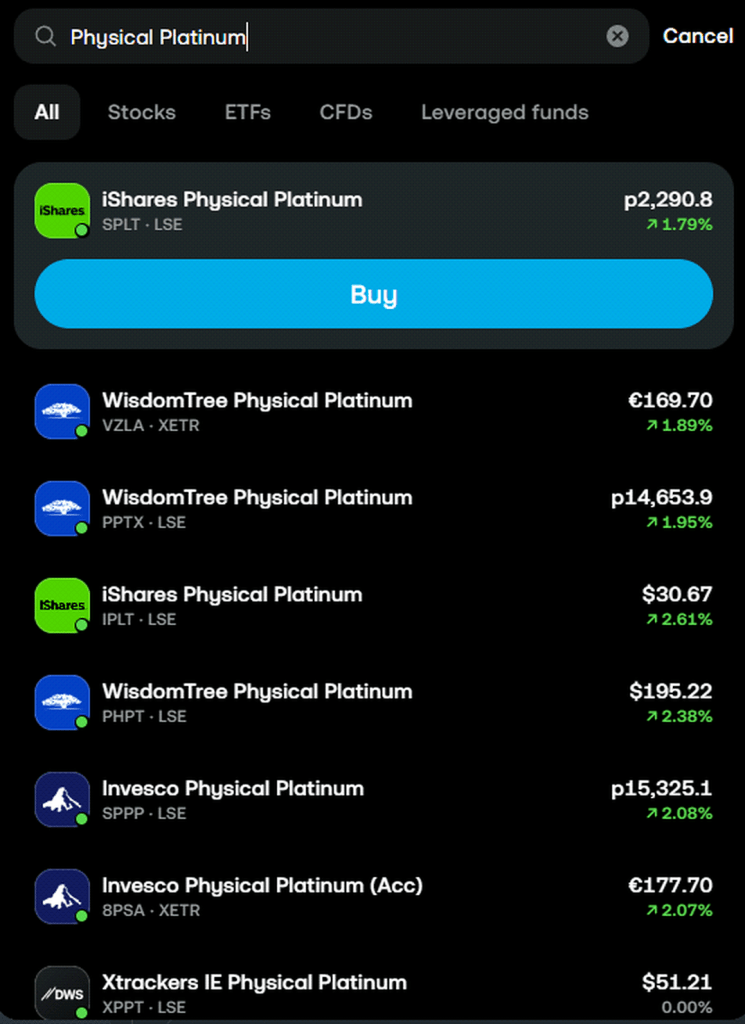
Open the search, the magnifying glass icon, and type Physical Platinum.
Filter to the ETFs section to find the standard trackers rather than leveraged or short products, which are complex daily tools unsuited to tracking the actual platinum price.
Step 2: Choosing Your Product
For 2026 the main option is WisdomTree Physical Platinum (PHPT), one of the most established physical platinum ETCs in Europe.
It is backed by allocated platinum held by HSBC as custodian, and only metal meeting the London Platinum and Palladium Association good-delivery rules is accepted.
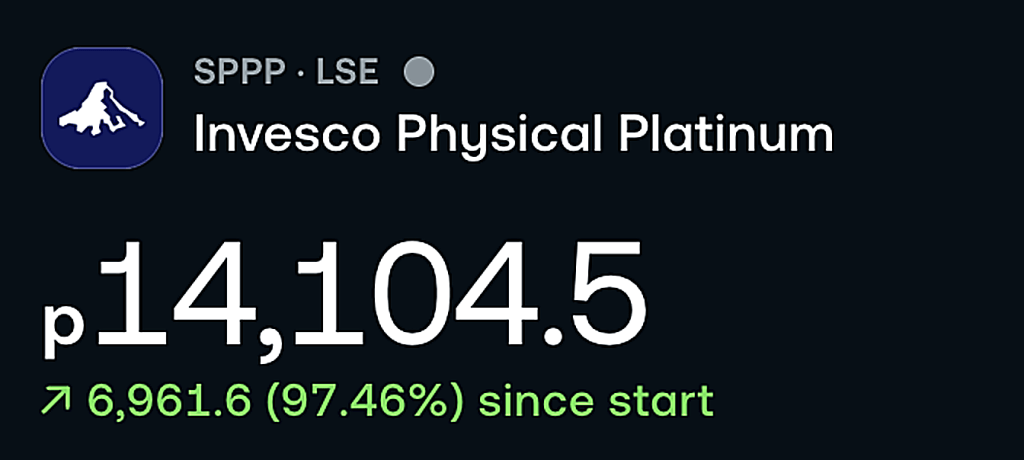
Invesco also lists a physical platinum product (SPPP) for those who prefer that provider, and you should look for the London-listed line in your account currency where possible.
Step 3: Checking the Details
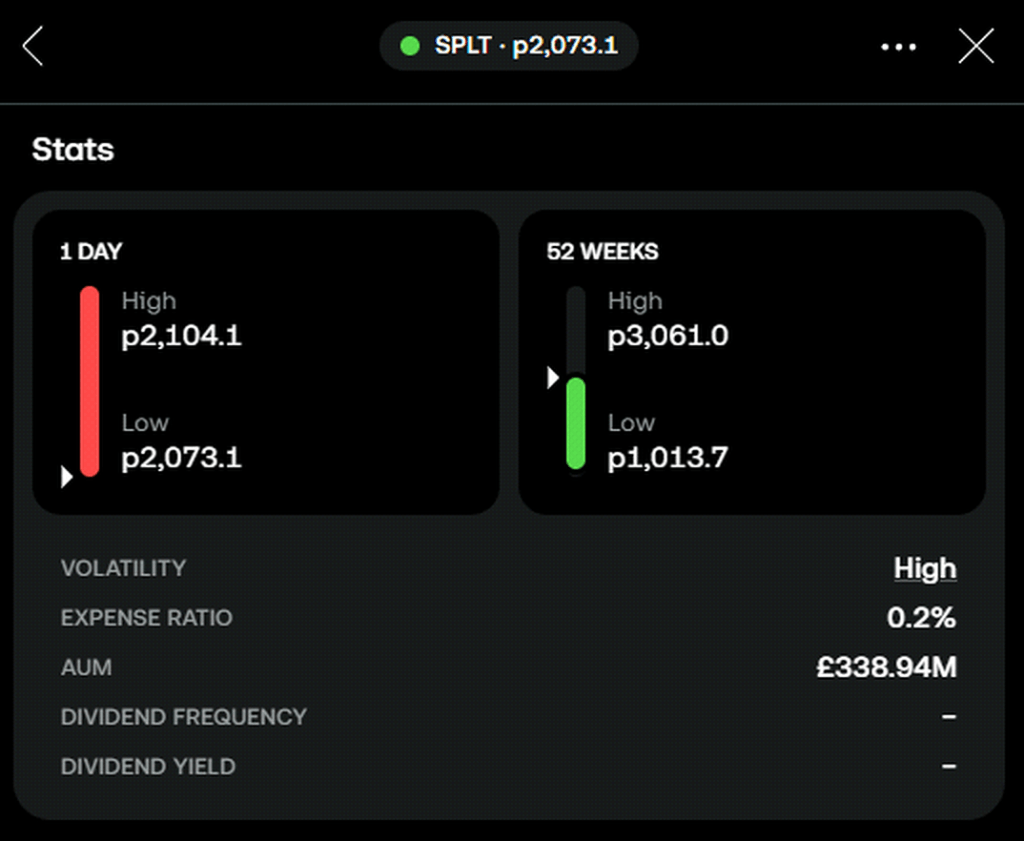
Click into the product and scroll to Instrument Details.
Expect an ongoing charge around 0.20%, shown as the expense ratio, which is competitive for the platinum space.
Then check the currency: most platinum ETCs are listed in USD, so confirm whether it says USD or GBP/GBX.
Step 4: Market vs Limit Orders
When you press buy you have a choice in the top right.
A market order buys instantly at the current price, which is convenient but can slip if the price moves while it processes.
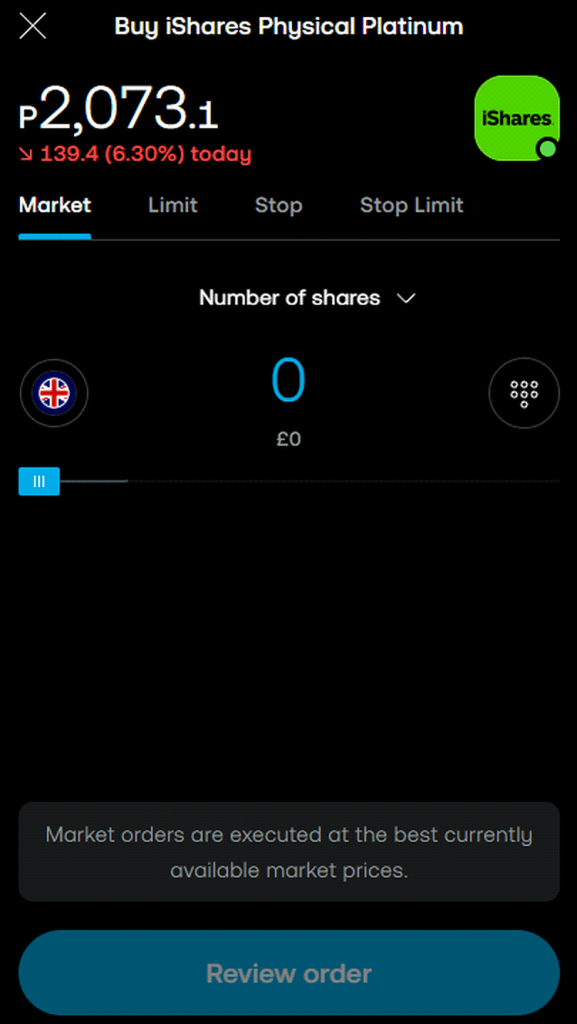
A limit order lets you set the exact maximum you will pay, and it only fills if the price dips to your level, giving you more control.
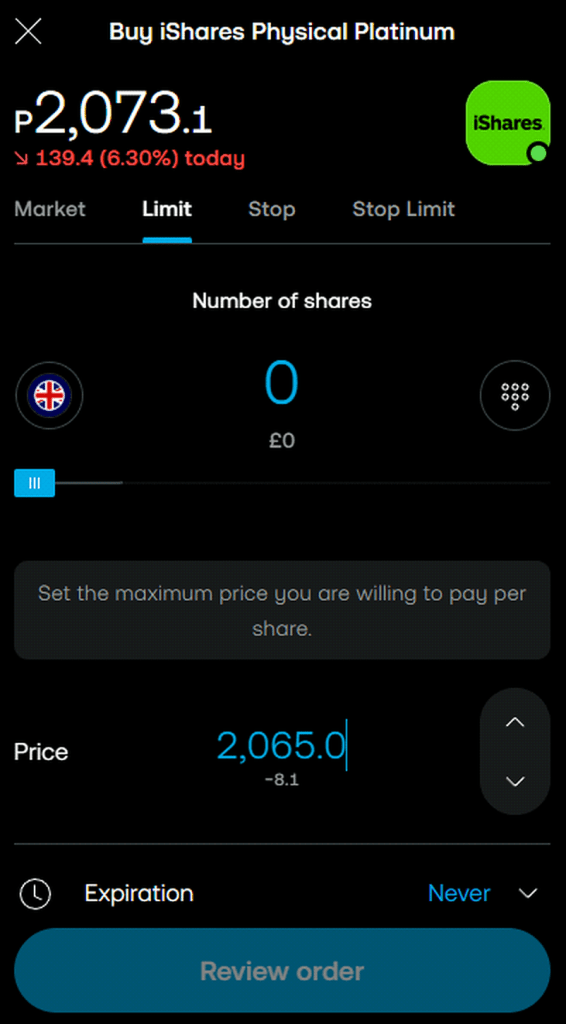
Market and limit orders are just the starting point. Trading 212 also offers stop orders, stop-limit orders, and other tools that can help you buy at a specific price or protect against sudden drops. For a full breakdown of how each order type works and when to use them, see our guide on Trading 212 order types.
Conclusion
For most people, a physically backed platinum ETC like PHPT is the simplest way to own platinum on Trading 212, and it avoids the 20% VAT charged on physical bars.
You should factor in the small currency fee or look for a GBP variant of the ETC, as many platinum ETCs are priced in dollars. Mining shares are a higher-risk alternative, but the ETC tracks the metal more directly, and you can buy it in a few taps with a limit order for control.
FAQ
Do I Pay VAT on Platinum via Trading 212?
No. Physical platinum bars are subject to 20% VAT in the UK. A platinum ETC is not, because you own a security representing vaulted metal rather than the bars themselves. (Tax treatment depends on your individual circumstances and regulations which may change.)
What Is the Best Platinum ETC?
WisdomTree Physical Platinum (PHPT) is the most established option on the platform. Compare the latest charges and currency line before you buy.
Can I Hold Platinum in an ISA?
Yes. You can hold Platinum ETCs in a Stocks and Shares ISA, so any gains are tax-free. (Tax treatment depends on your individual circumstances and regulations which may change.)
Why Is Platinum More Expensive to Hold Than Gold?
Platinum ETCs typically have a slightly higher ongoing charge, around 0.20%, because the platinum market is smaller and more niche than gold.