
Published 3 July 2026
The Trading 212 ETC Questionnaire is a short appropriateness check you’ll complete before buying ETCs and other complex products. It takes only a few minutes, isn’t a traditional pass-or-fail test, and simply checks that you understand how these investments work.
In this guide, we’ll explain why Trading 212 asks the questions, when the questionnaire appears, what it asks, and what happens if you don’t complete it.

Key Takeaways
- ETCs are classed as complex products, so Trading 212 must check you understand them before you buy.
- The questionnaire is a short set of knowledge and experience questions, not a credit or income check.
- It applies to the Invest account and the Stocks and Shares ISA, and appears at your first complex-product order.
- If you already hold one, you get three months to complete it before new buy orders are blocked.
- It is free, one-off, and takes only a few minutes.
- The questionnaire is about eight multiple-choice questions on how ETCs, leverage and inverse products work, all explained below.
What Is the Appropriateness Questionnaire?
Under UK rules, a broker has to check that a complex product is appropriate for you before you buy it. Trading 212 does this with a short appropriateness assessment.
It evaluates your knowledge and experience with complex instruments, which can behave differently from ordinary shares and, in some cases, multiply losses.
For ETCs specifically, it makes sure you understand how the product tracks a commodity price.
Which Products Trigger It
The questionnaire is not limited to ETCs. Trading 212 applies it to a group of complex products: exchange-traded commodities (ETCs), other exchange-traded products (ETPs), and leveraged or inverse funds.
Ordinary shares and standard ETFs do not trigger it. Because most single-commodity trackers, whether gold, silver, oil or copper, are ETCs, you will usually meet the questionnaire the first time you try to buy one.
When and Where It Appears
The appropriateness assessment is relevant to the Invest account and the Stocks and Shares ISA. It appears at the point you start placing an order for a complex product, so you complete it in the app or on the web just before your first purchase.
If you already hold a complex instrument, Trading 212 asks you to complete the test and gives you three months to do so.
After that, no new buy orders go through until it is done, though you can still hold or sell what you already own.
What the Questionnaire Asks
The questions are about your knowledge and experience, not your finances. Expect a handful of multiple-choice questions on how complex products such as ETCs work, the risks involved, and how much trading experience you have.
There is no income or credit check. If you understand that an ETC tracks a commodity price and carries risk, you will be comfortable with the questions.
The Questions and What They Mean
The questionnaire is a short set of multiple-choice questions, and it is not a pass-or-fail exam. It simply checks that you understand how these products work.
Below is each question Trading 212 currently asks for ETCs, with a plain explanation of what it is really getting at. Even if your answers suggest limited experience, you are normally shown a warning rather than blocked. The exact questions can change, so treat this as a guide rather than a script.
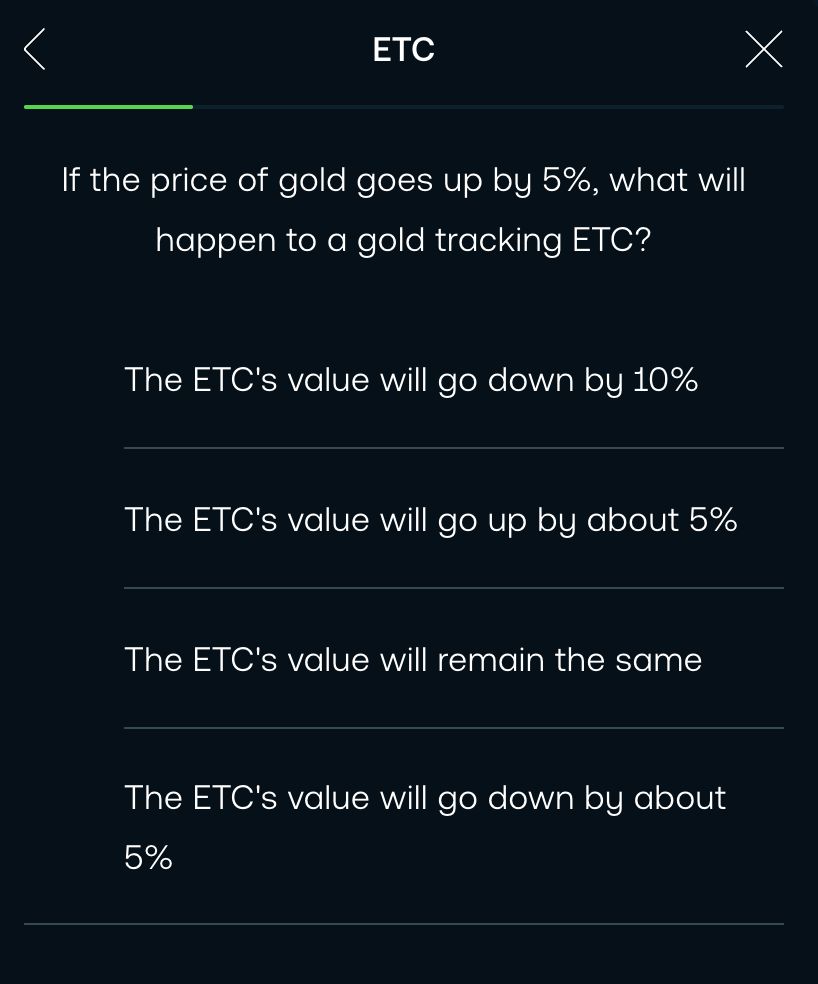
1. If the price of gold goes up by 5%, what happens to a gold-tracking ETC?
This question is about how a standard gold-tracking ETC usually moves when the price of gold changes. It checks whether you understand that these products are designed to follow the price of the commodity they track.
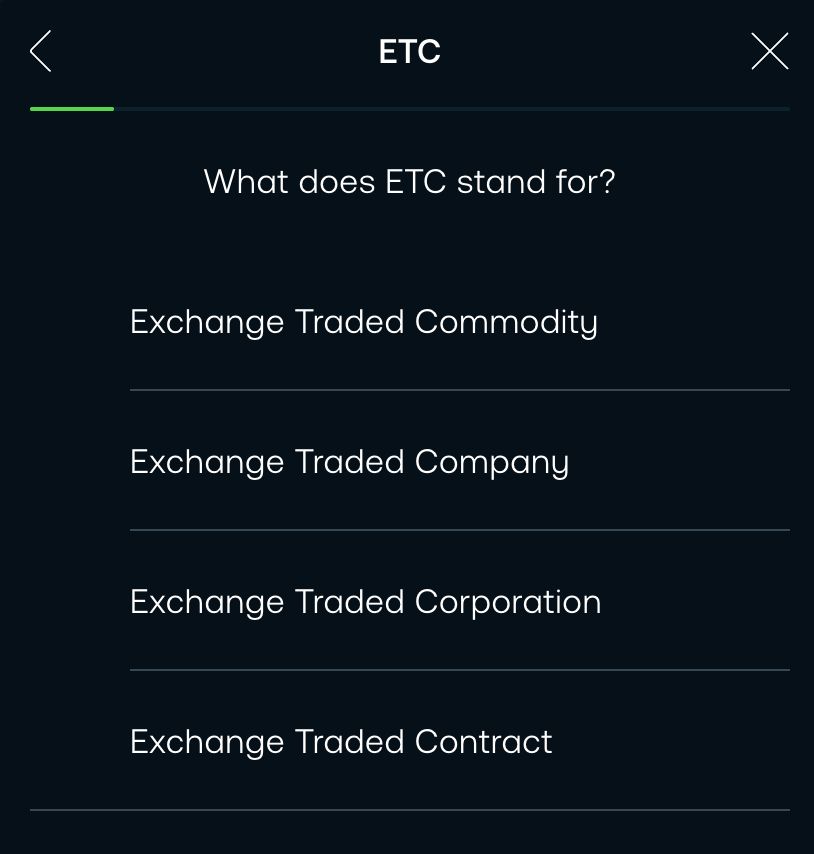
2. What does ETC stand for?
This question is about recognising what the term “ETC” means. It checks whether you understand the basic name of the product before looking at how it works.
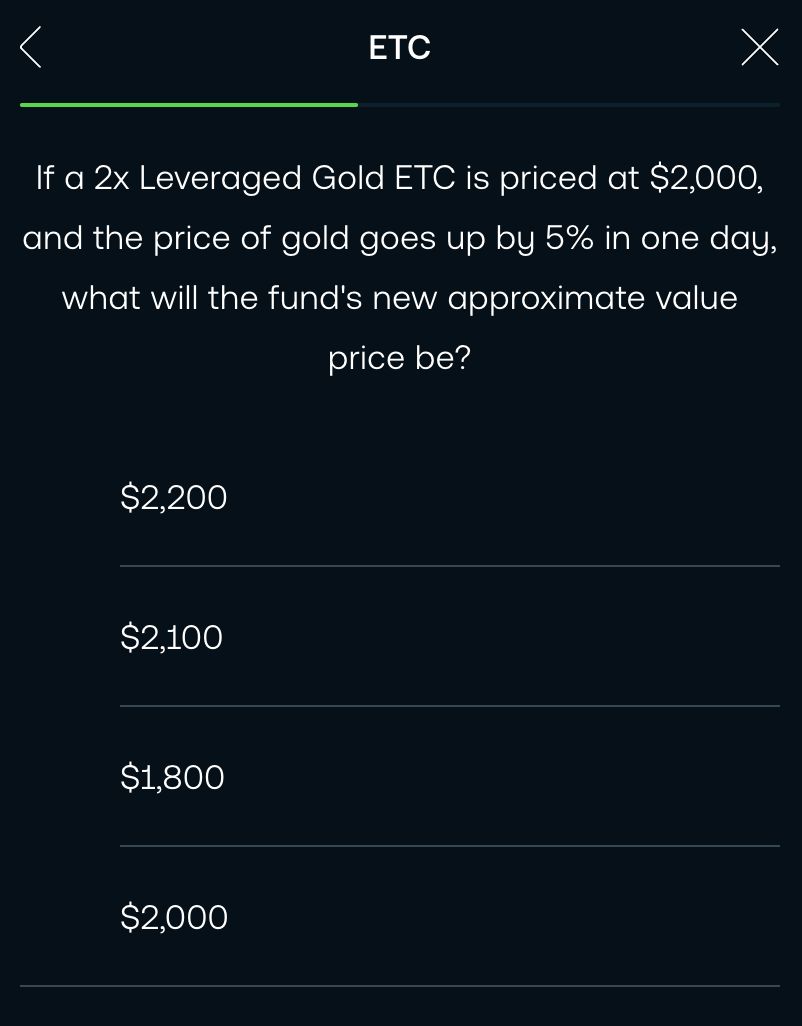
3. A 2x leveraged gold ETC is priced at $2,000 and the price of gold goes up by 5% in one day. What will the fund’s new approximate value price be?
This question is about how leverage affects the daily movement of an ETC. It checks whether you understand that a 2x product is designed to make a larger move than the commodity itself.
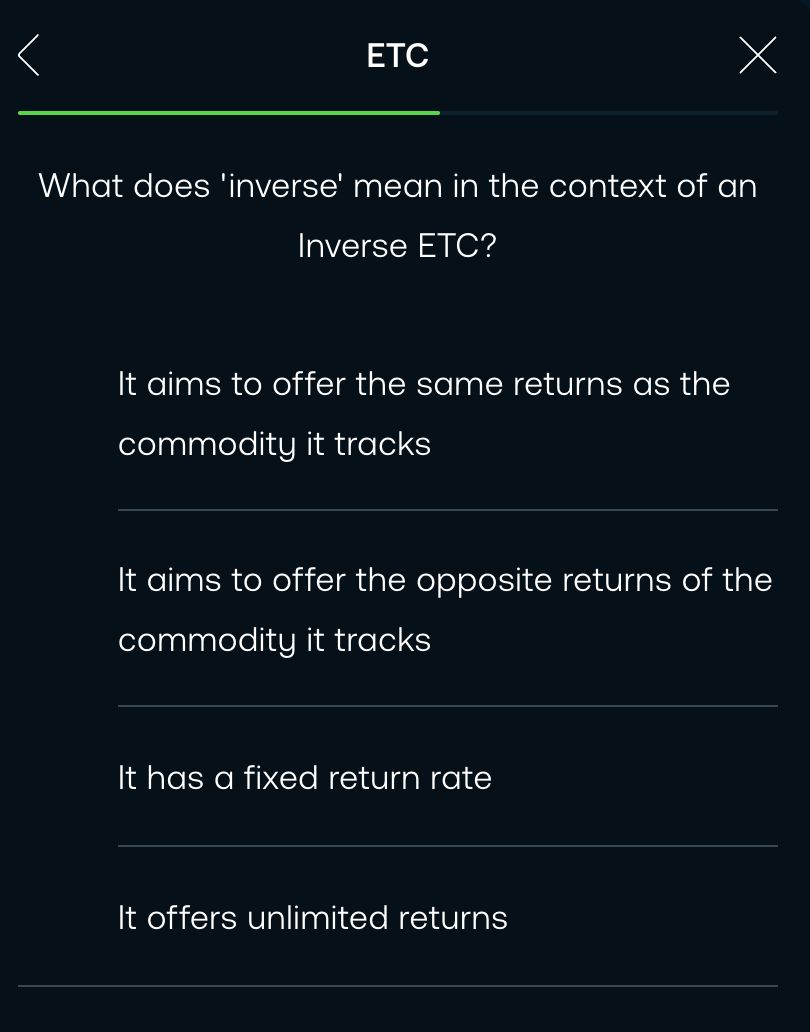
4. What does “inverse” mean for an inverse ETC?
This question is about understanding a key feature of a specific type of ETC. It checks whether you know what the word “inverse” means.
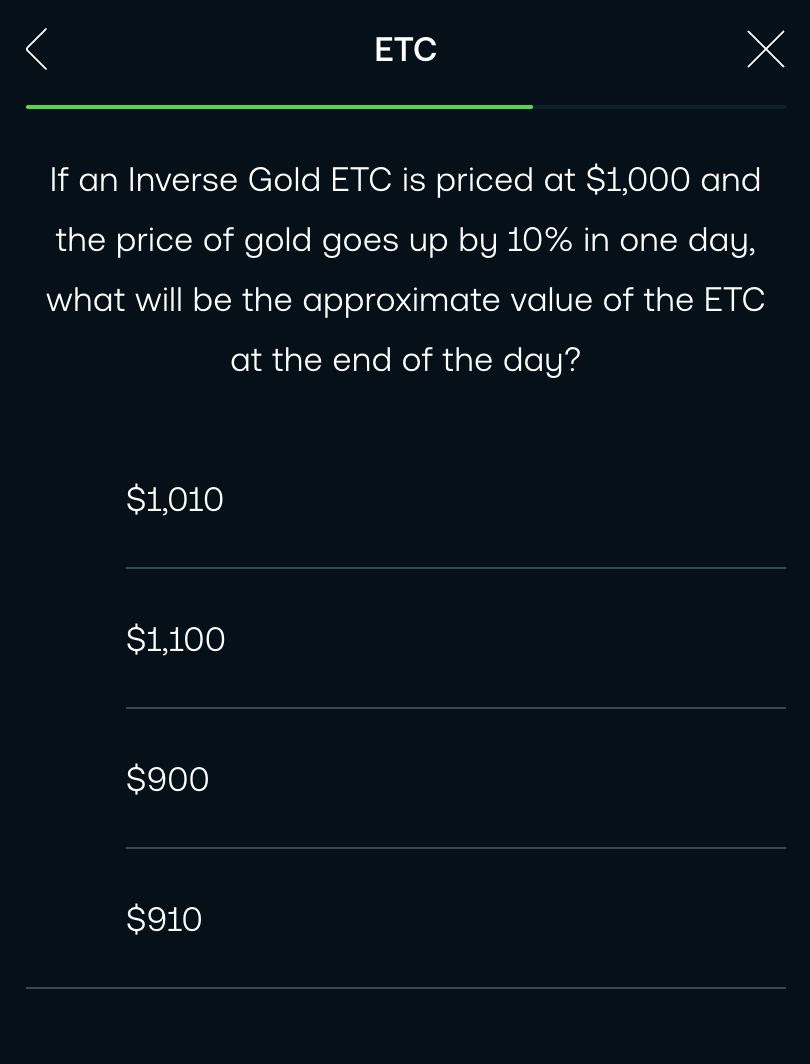
5. An inverse gold ETC is priced at $1,000 and gold rises 10% in a day. What is its approximate end-of-day value?
This question is about using the product type and the daily price move together. It checks whether you can work out the estimated value after the change.
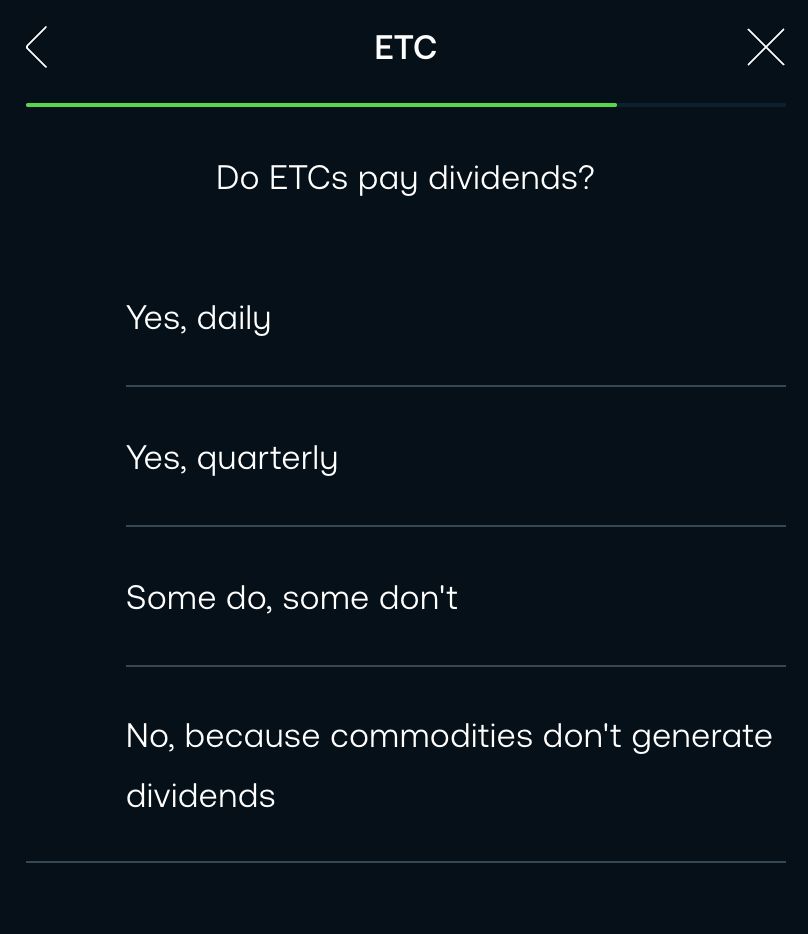
6. Do ETCs pay dividends?
This question is about whether this type of investment product is normally linked to dividend income. It checks whether you understand how ETCs differ from investments in companies.
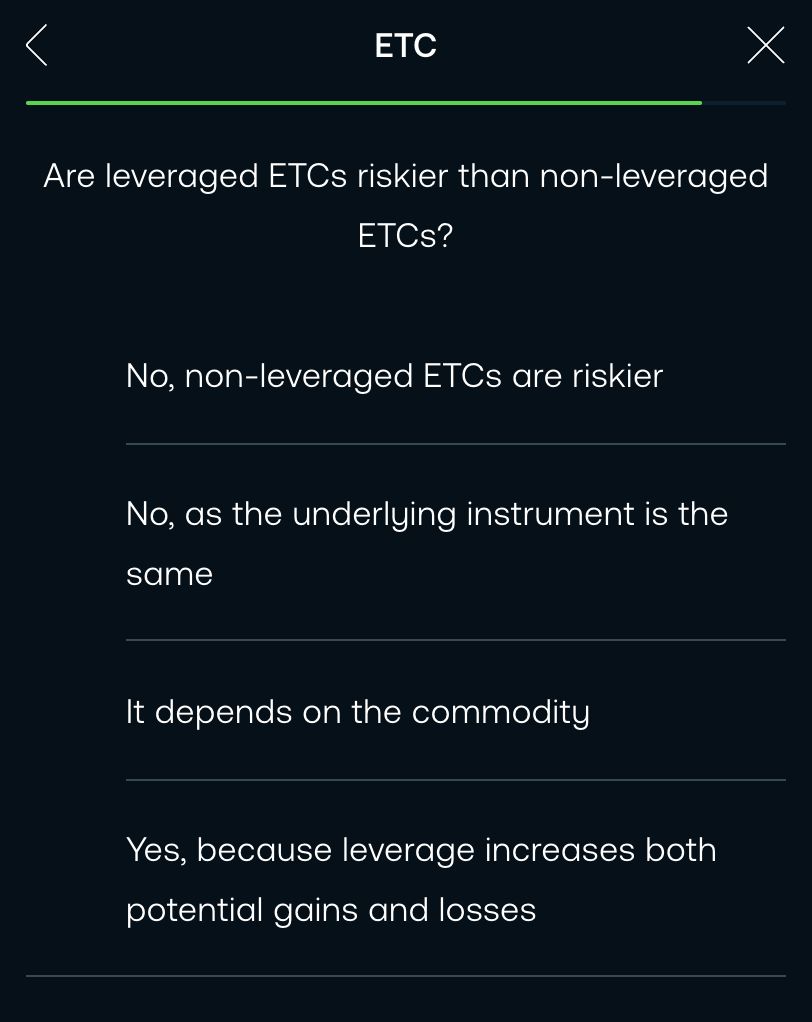
7. Are leveraged ETCs riskier than non-leveraged ETCs?
This question is about comparing the risk level of two different types of ETCs. It checks whether you understand how the structure of the product can affect risk.
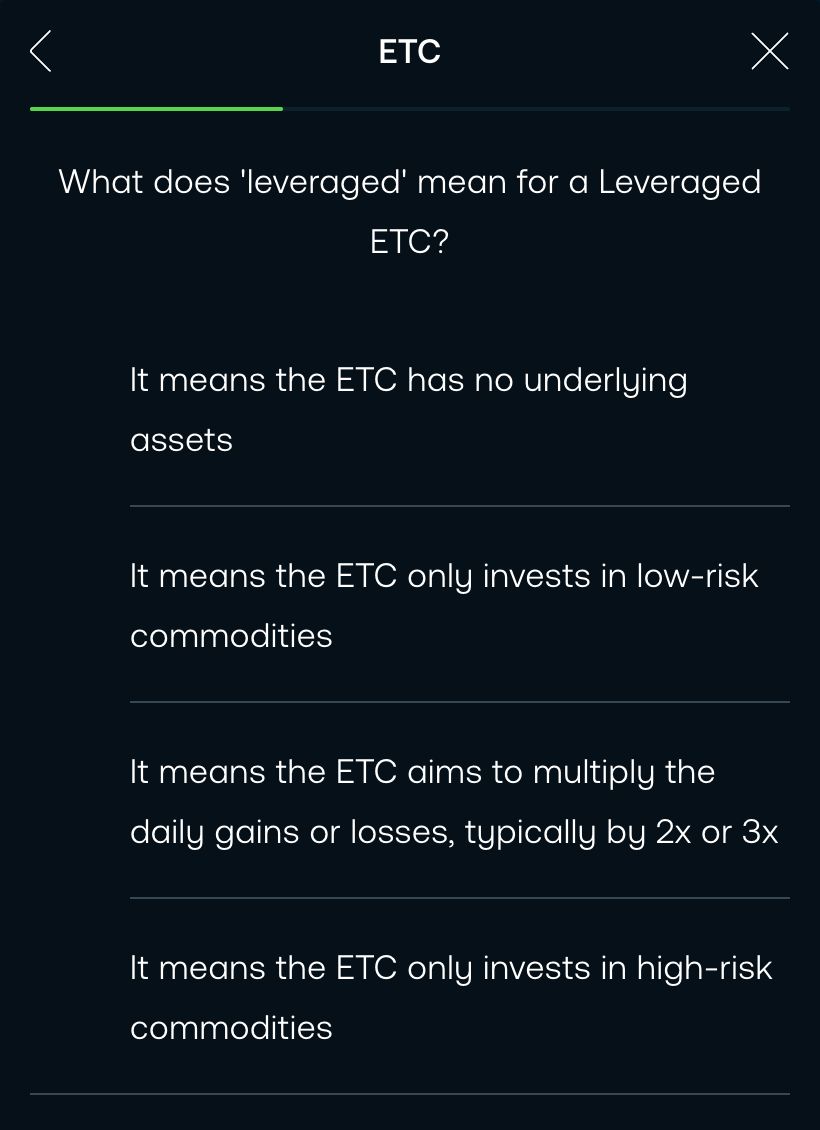
8. What does “leveraged” mean for a leveraged ETC?
This question is about understanding an important investing term. It checks whether you know what “leveraged” means when it is used to describe an ETC.
After You Finish
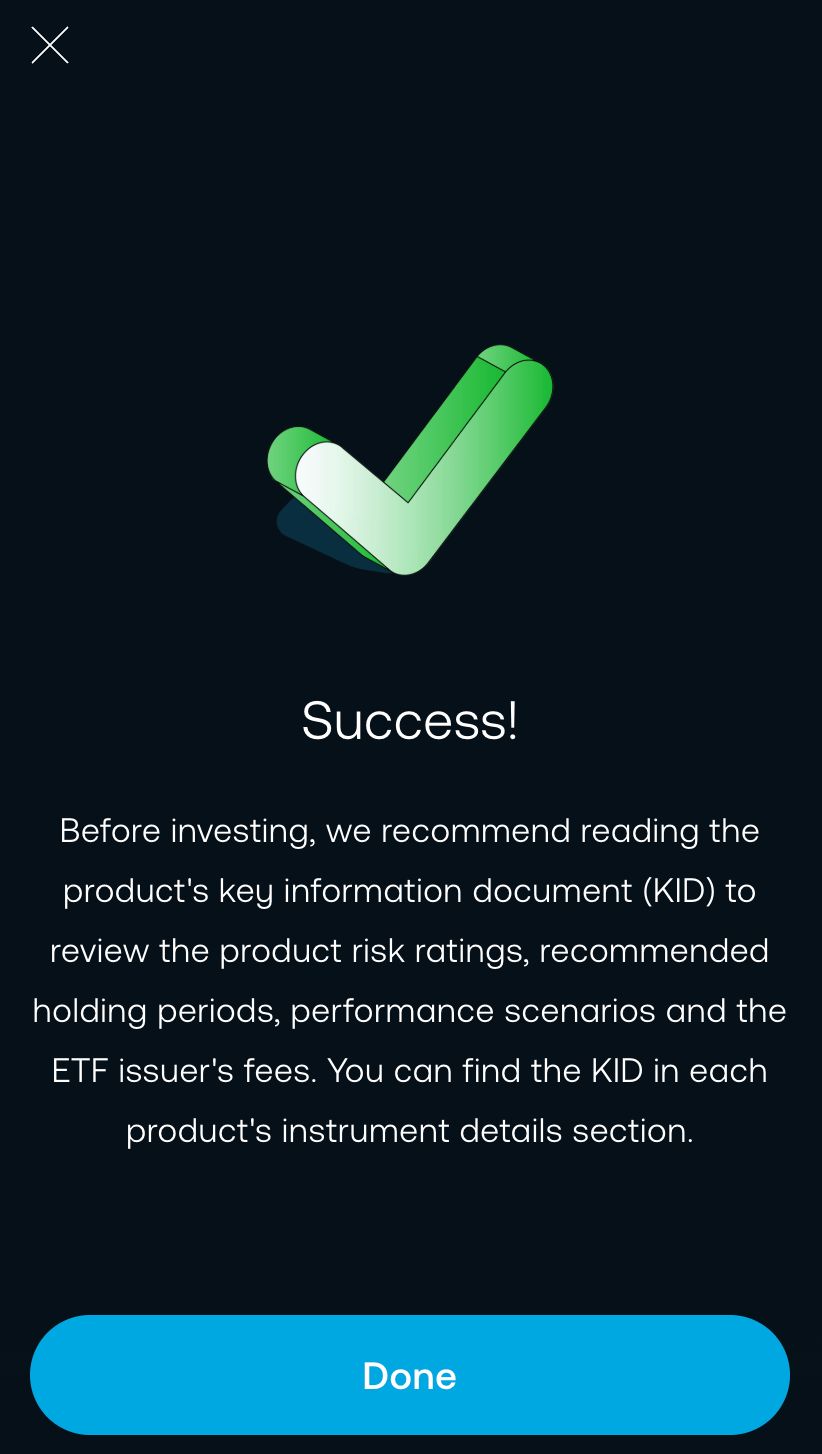
Once you answer, Trading 212 shows a success screen and recommends reading each product’s Key Information Document (KID) before you invest. You will find the KID in the instrument details, covering the risk rating, recommended holding period, performance scenarios and fees.
How to Complete It
When the questionnaire appears, read each question, choose the answer that best reflects your understanding, and submit. It takes only a few minutes and you complete it once.
If any answers suggest you are not yet familiar with the product, Trading 212 may show a warning or ask you to confirm you understand the risks before you continue.
Taking a moment to learn how ETCs work first makes the whole thing straightforward.
What Happens If You Do Not Complete It
If you skip it, you simply cannot place buy orders for complex products.
For a new position, that means you cannot buy the ETC until the questionnaire is done.
For an existing position, you have three months before buy orders are blocked, although you can still hold or sell what you already own.
Completing the questionnaire removes the block.
Conclusion
The Trading 212 ETC questionnaire is a short, one-off appropriateness check, not a hurdle to worry about.
It applies to ETCs and other complex products in the Invest and ISA accounts, appears when you first try to buy, and takes only a few minutes.
Once it is done, you can buy commodity ETCs as easily as any share. If you are new to this, our guide on how to buy commodities is the best place to start.
FAQ
Do I Have to Take the Trading 212 ETC Questionnaire?
Yes, if you want to buy an ETC or another complex product. It is a one-off appropriateness check required before your first purchase.
Can You Fail the Appropriateness Test on Trading 212?
It is not pass-or-fail in the usual sense. If your answers suggest limited experience, you may see a risk warning, but you can still choose to proceed after confirming you understand.
Does the Questionnaire Apply to an ISA?
Yes. It applies to both the Invest account and the Stocks and Shares ISA.
How Long Does It Take?
Only a few minutes, and you complete it once.