
Updated 3 July 2026
If you believe natural gas prices will spike on a cold snap, supply disruption or geopolitical event, NGSP can be an effective way to express that view. You can get natural gas exposure in minutes through an investment that follows the price of natural gas, bought as easily as a single share. This guide shows exactly how to buy natural gas on Trading 212, the main product to use, the hidden costs to watch, and how to place your order.
Natural gas is one of the world’s most volatile commodities, with prices swinging sharply during events such as the European energy crisis and growing global demand for LNG. Unlike gold or silver, however, these investments have ongoing costs that can significantly reduce long-term returns. We explain why they are generally better suited to short-term trades than buy-and-hold investing.

Key Takeaways
- There is no physical natural gas ETC; products track the price using futures contracts.
- Natural gas is among the commodities most affected by contango, which can heavily erode long-term returns.
- The main product is WisdomTree Natural Gas, listed as NGAS (USD) and NGSP (GBP), around 0.49% a year.
- Gas ETCs are best used for short-term tactical trades, not buy-and-hold.
- Avoid leveraged products such as 3NGL unless you are an experienced intraday trader.
What You Are Actually Buying (Digital vs Physical)
First, let us clear up the misconception. When people say they are buying natural gas on Trading 212, they do not mean a gas canister arriving at their front door.
Unlike gold or silver, there is no investment product backed by physical natural gas. Natural gas is a consumable commodity that must be stored under pressure or at extremely low temperatures, making physical storage impractical for an investment product.
Instead of owning physical gas, you are buying an investment that aims to follow the price of natural gas. It trades on the stock market just like a share, so you can buy and sell it through Trading 212.
This type of investment is called an Exchange-Traded Commodity (ETC). Because it cannot hold physical natural gas, it tracks the price using futures contracts instead.
Natural gas is one of many raw materials you can access this way, and our guide on how to buy commodities covers the full range.
How Do Natural Gas ETCs Work?
Natural gas ETCs use a synthetic, futures-based approach. The provider buys gas futures, which are agreements to buy gas at a future date at a set price, and replaces them with new contracts as they approach expiry. This means the ETC tracks the price through futures rather than by holding physical gas.
The downside is that replacing these contracts is often expensive. New contracts frequently cost more than the ones being replaced, creating a drag on returns even if the price of natural gas does not change much. This effect is known as contango, and the loss from repeatedly replacing contracts is called negative roll yield.
Natural gas is one of the commodities most affected by this because the price of future contracts is often much higher than the current price. As a result, long-term holders can see returns eroded even if the spot price stays flat or rises slightly.
ETCs vs Gas Company Stocks: Which Is Better?
Natural gas price ETCs are designed to track the gas price through futures.
The main product, WisdomTree Natural Gas (NGSP), aims to follow the Bloomberg Natural Gas SubIndex, so if prices spike on a cold winter or supply disruption your ETC should broadly move in line. It is the most direct exposure for short-to-medium-term traders.
Gas company shares are a different game. Gas producers are different. Companies like Shell (SHEL), BP (BP.), Centrica (CNA), and US producer EQT can benefit from higher gas prices, but many other factors influence their share prices.
If it costs $2.00 per unit to produce gas and it sells for $3.50, profit is $1.50. A 29% rise to $4.50 lifts profit to $2.50, a 67% increase.
It works both ways, though. Rising costs, pipeline disruptions, regulation, or hedging losses can hurt the share price even when gas is trading at seasonal highs.
Things to Watch Out For (Fees, Currency and Contango)
The contango problem is critical for natural gas, arguably the commodity most affected by it. Imagine you have to renew a subscription every month, but each renewal costs a little more than the last. You keep paying the higher price just to stay invested, even if nothing else changes. That extra cost is what contango represents.
Because gas has strong seasonal demand, higher in winter and lower in summer, the futures curve is often in steep contango, so the next contract is frequently much dearer than the current one.
Every roll can lose a meaningful amount, and over years, this dramatically erodes returns. If you bought and held a gas ETC for five years, you could lose money even if the spot price ended higher. On costs, Trading 212 charges a 0.15% currency conversion fee.
The USD line NGAS attracts it for Trading 212 accounts with GBP as the base currency, while the GBP line NGSP avoids it.
The ongoing charge is around 0.49%, but remember the real drag is the contango, which can far exceed the management fee, and GBP-hedged options are more limited for gas than for oil.
The ETC Questionnaire
There is also one quick step to know about before your first purchase. Because ETCs are classed as complex products, Trading 212 may ask you to complete a short appropriateness questionnaire before you can buy one. Our guide to the Trading 212 ETC questionnaire explains exactly what it asks and how to complete it.
How to Buy Natural Gas on Trading 212: Step by Step
Step 1: The Search
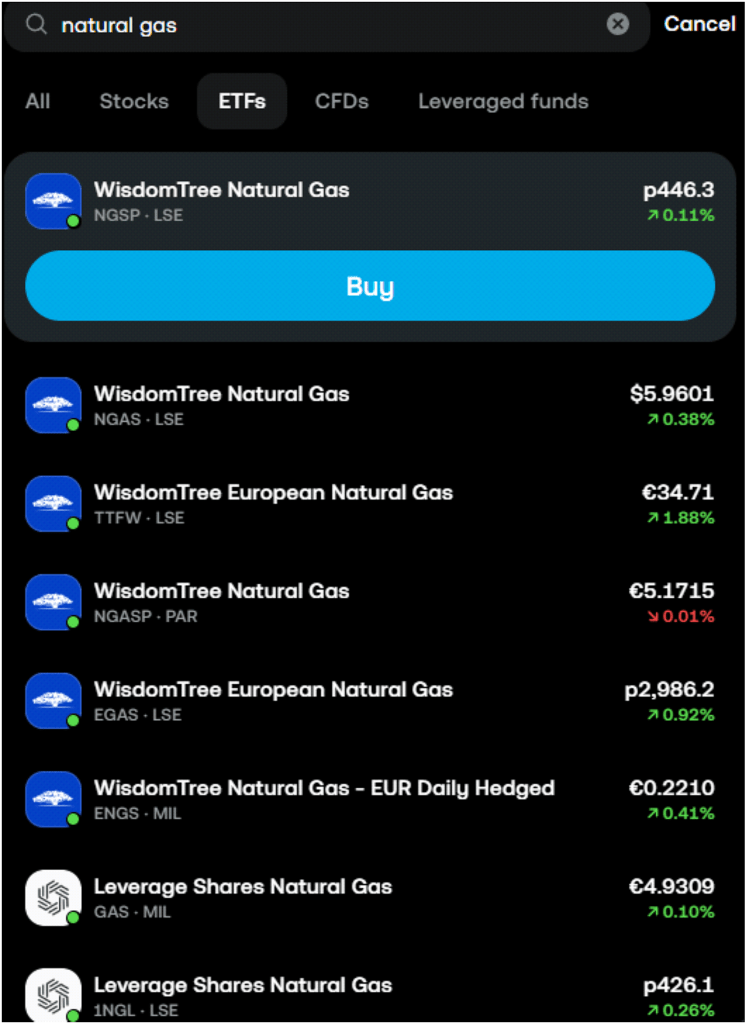
Open the search, the magnifying glass icon, and type Natural Gas.
Some results are leveraged, such as WisdomTree Natural Gas 3x Leveraged (3NGL), which amplify daily moves by three times, decay rapidly and are designed only for intraday traders. Filter to the ETFs section to find the standard trackers.
Step 2: Choosing Your Product
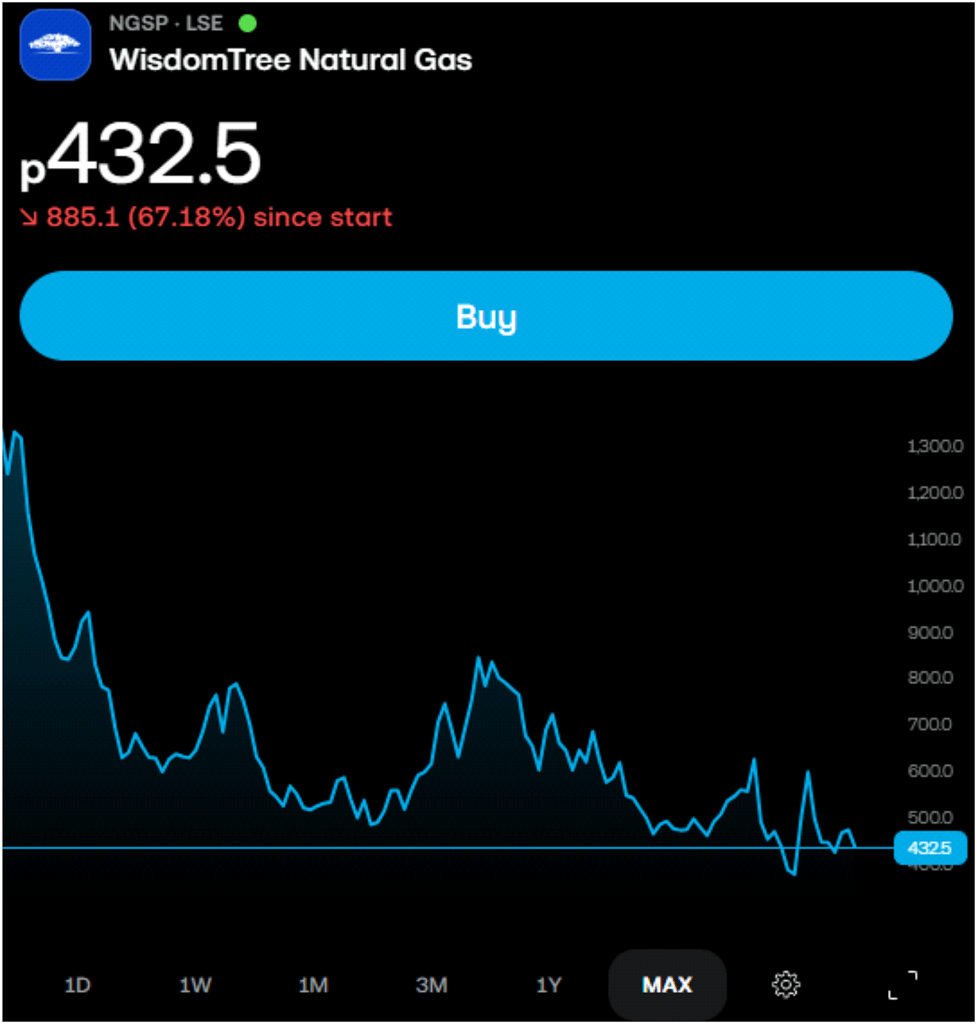
For 2026, the main option is WisdomTree Natural Gas (NGSP), which tracks the Bloomberg Natural Gas Subindex through futures contracts. It is also the most liquid natural gas ETC on the London Stock Exchange.
Unlike gold or silver, where several providers compete, natural gas ETCs offer far fewer choices. As a result, NGSP is the standard option for most investors.
There is also a USD-denominated line, NGAS, where pound accounts should factor in the 0.15% currency fee.
An Important Warning
Because of contango, it is worth repeating: gas ETCs like NGSP are best used for short-term tactical positions.
If you believe gas prices will spike because of a cold snap, supply disruption, or geopolitical event, NGSP can be an effective way to express that view.
But holding it for months or years as a set-and-forget investment is generally not advisable because of the roll cost.
Step 3: Checking the Details
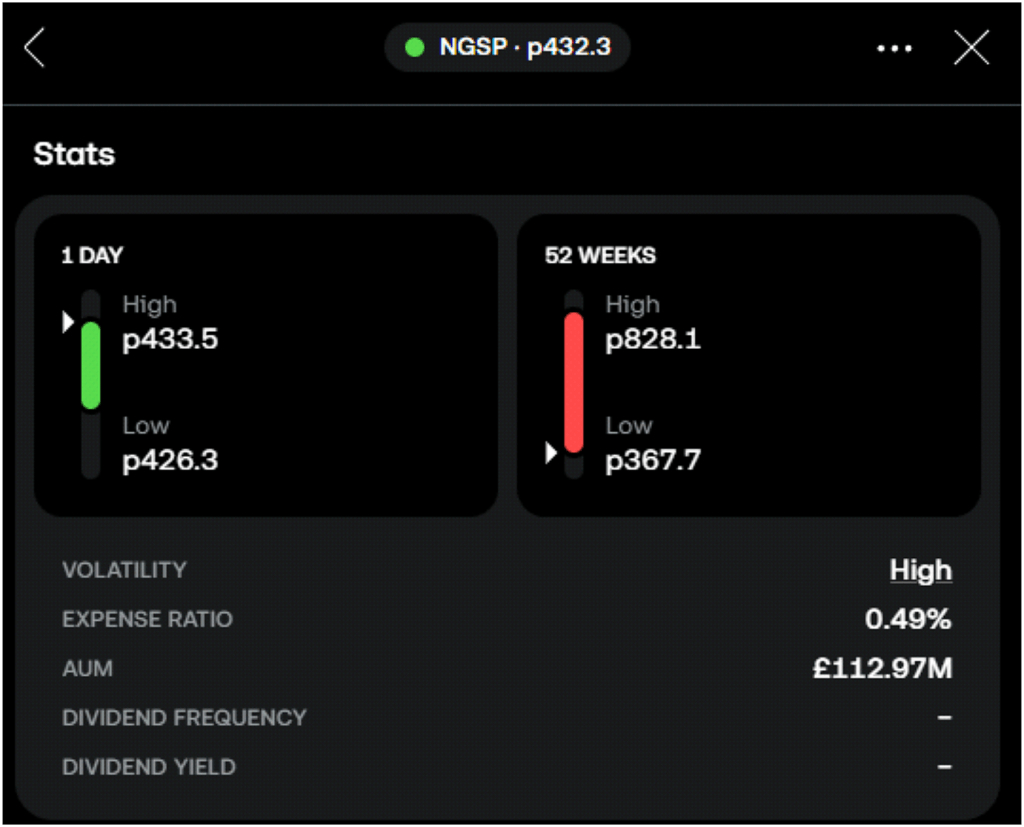
Click into the product and scroll to Instrument Details.
Expect an ongoing charge around 0.49%, shown as the expense ratio, but remember the real cost of holding a gas ETC is the contango drag, which can far exceed it.
Then check the currency: NGSP is in pounds, while NGAS is in USD and attracts the 0.15% fee for pound accounts.
Step 4: Market vs Limit Orders
When you press buy you have a choice in the top right. Natural gas can be extremely volatile, so a market order, which fills instantly, can slip significantly while it processes.
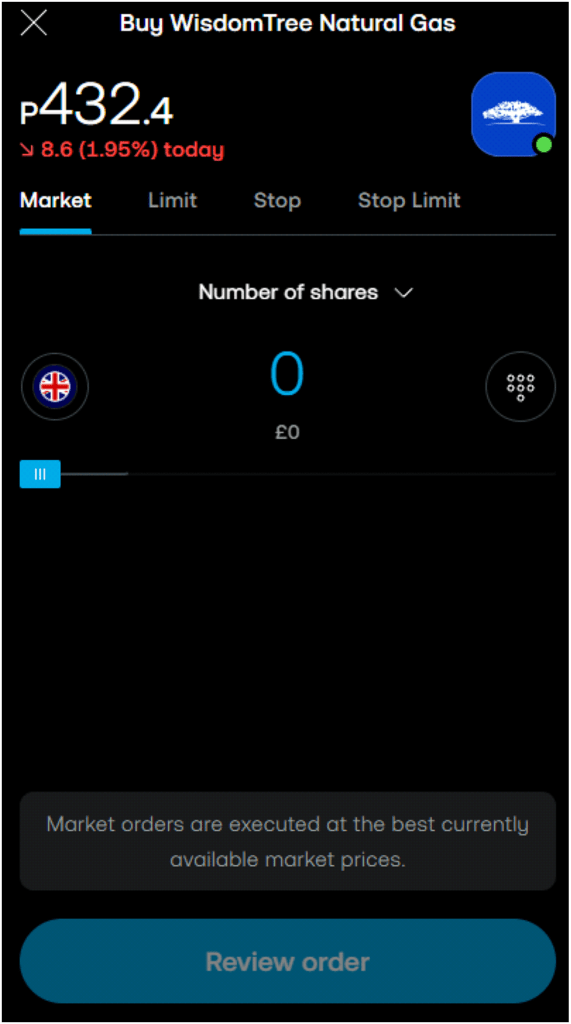
A limit order, especially important here, lets you set the maximum you will pay; if NGSP trades at 432.2p you might set a limit at 430p, and it only fills if the price dips to your level.
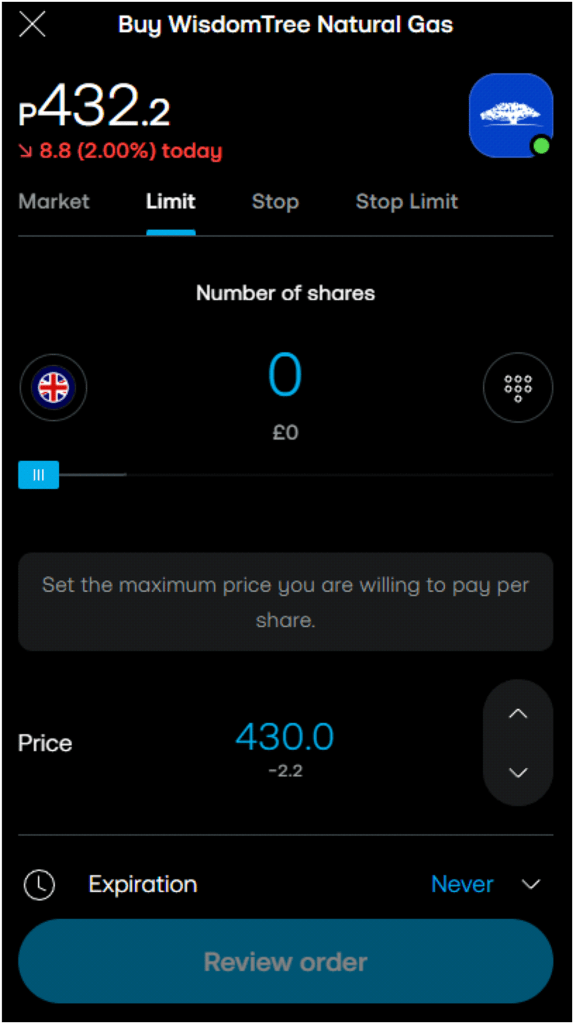
Market and limit orders are just the starting point. Trading 212 also offers stop orders, stop-limit orders, and other tools that can help you buy at a specific price or protect against sudden drops. For a full breakdown of how each order type works and when to use them, see our guide on Trading 212 order types.
Conclusion
For most investors, a natural gas ETC such as NGSP is the most direct way to gain exposure to gas prices on Trading 212. Because heavy contango can drag on returns, it is generally better suited to short-term positions than long-term holding.
Choose the GBP-listed line where available to avoid the 0.15% currency conversion fee. It is also best to avoid leveraged products, which are designed for short-term trading rather than investing. For a short-term view on where gas prices are heading, a standard natural gas ETC is a simple and direct choice.
FAQ
Can I Buy Physical Natural Gas on Trading 212?
No. There is no physical gas ETC. You buy an ETC that tracks the natural gas price using futures contracts.
Why Are Natural Gas ETCs Bad for Long-Term Holding?
Natural gas has a steep, seasonal futures curve, so contango drag from rolling contracts can erode returns heavily over time, sometimes leaving you down even if spot gas rises.
NGAS or NGSP?
They are the same WisdomTree exposure in different currencies: NGSP trades in pounds and avoids the 0.15% currency fee for UK investors, while NGAS trades in dollars.
Should I Avoid Leveraged Gas Products?
Leveraged products like 3NGL are designed for intraday traders, decay rapidly and are unsuitable for simply tracking the gas price. Most investors should avoid them.