
Updated 30 October 2026
Trading 212 can pay interest on uninvested cash, but it is an option you have to switch on, and turning it on slightly changes where your money is held and its respective protections. Money you have added but not yet invested does not have to sit there doing nothing.
Both points are worth understanding before you decide.
This guide explains how interest on cash works, what rate to expect, where the money actually sits, and whether it is worth enabling for the cash you are holding between investments.

Key Takeaways
- You have to opt in: interest on uninvested cash is a feature you switch on yourself.
- Paid daily: interest builds up every day and is added to your account.
- A variable rate: the rate moves with wider interest rates, so it changes over time.
- Where it is held: if you turn the interest feature on, your cash is held in money market funds and banks rather than banks alone.
What Is Interest on Cash?
When you add money to your Invest account or Stocks and Shares ISA, it sits as cash until you invest it.
Interest on cash lets that idle balance earn something in the meantime, rather than waiting unproductively while you decide what to buy.
It is worth being clear that this is a separate concept from the Trading 212 Cash ISA, which is a savings account in its own right with its own rate and rules. Interest on cash is simply a feature applied to the uninvested balance inside an investing account. The two are easy to mix up because both involve cash and interest, but they are different products.
If you are new to how the accounts fit together, our guide on how to use Trading 212 sets them side by side.
In practice, most investors hold some cash without really meaning to, money deposited but not yet invested, dividends waiting to be reinvested, or a buffer kept back for a buying opportunity. Interest on cash pays you on that idle balance, so it’s worth more the more cash you leave sitting between investments.
How Does It Work?
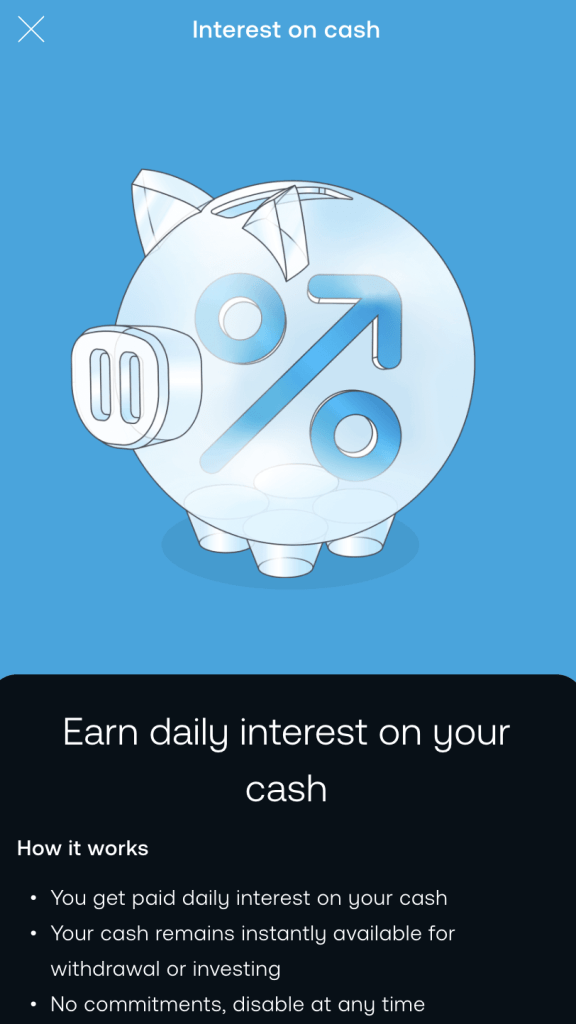
Interest on cash is something you choose to switch on. It is not applied automatically, so an uninvested balance earns nothing until you enable the feature.
Once you do, Trading 212 holds your uninvested cash in a way that generates interest. It then pays that interest to you regularly.
The mechanism matters because it changes where the money sits. With interest enabled, part of your cash is held in money market funds rather than only in banks.
Money market funds are tightly regulated, low-risk funds that hold assets such as short-term government debt. They are conservative by design, but they are different from cash held in a bank.
That difference is the trade-off you accept in exchange for earning interest.
The interest is paid out regularly rather than in one annual lump sum. This allows it to compound over time.
Once paid, the interest is added to your balance and can earn interest itself in future periods. On a small balance, the effect is minor. However, it is the same mechanism that helps any interest-bearing balance grow faster over time.
It’s also worth remembering this is never locked in: you can switch interest off at any time from the “Interest on cash” dashboard, which moves your cash back to the bank holding.
What Rate Do You Get?
The rate is variable and moves in line with wider overnight interest rates, which themselves follow the broader rate environment.
That means it is not a fixed promise: when general interest rates rise the rate tends to rise, and when they fall it falls with them.
The practical consequence is that you should not rely on a figure you saw quoted months ago.
Always check the current rate inside the app before assuming what you will earn, because it can change as the wider environment does.
As a rough way to gauge the scale rather than a quoted figure: if the rate were around 4%, a £1,000 cash balance left for a year would earn roughly £40, and on a balance of £5,000 it will be about £200.
The real rate moves with the wider environment, so treat those purely as illustrations of how the maths works, and check the live number in the app before relying on any figure.
Is Your Cash Safe?
Your cash is held in regulated, protected arrangements either way, but no setup is risk-free, and the protection works differently depending on one setting.
With interest switched off, all your cash is held in banks and covered by the FSCS up to £120,000. Nothing sits in investments.
With interest switched on, your cash is split between banks and Qualifying Money Market Funds (QMMFs). The bank-held portion keeps its FSCS cover.
The QMMF portion does not. It’s classed as an investment, so if the fund itself ever lost value, that would count as an investment loss and isn’t compensated by the FSCS.
You should know about the scale of that impact here, because “uncompensated investment loss” sounds worse than the reality of the situation.
QMMFs hold short-dated, high-quality debt and are designed to keep a stable value. In the rare cases where one has slipped below that value (known as “breaking the buck”), the shortfall has been a few percent, not a wipeout. The most-cited example, during the 2008 crisis, saw a fund settle at around 97 cents on the dollar.
So the realistic risk is losing a small fraction of the QMMF portion in an extreme event, not your cash disappearing. That residual risk is what you take on in exchange for the interest.
You can see exactly how your cash is divided between banks and QMMFs at any time in the interest dashboard, and it’s listed in your monthly statements. You can also switch interest off whenever you like, which moves your cash back to being held at teh bank
For the wider question of how your money is protected on the platform, including segregation and the FSCS, see our guide on whether Trading 212 is safe.
What are the risks of QMMFs?
Trading 212 lists four risks for the qualifying money market funds (QMMFs) it uses. None is particularly high or likely under normal conditions, but it’s still worth knowing what they are so you can make an informed decision whether to turn the interest on uninvested cash feature on.
Credit risk
A QMMF lends to banks and institutions by holding their short-term debt. If one of those borrowers became insolvent, the fund could lose a little value, and that could feed through to your cash. Trading 212 says it manages this by using only high-quality funds.
Management risk
A QMMF is actively run, so the manager’s decisions affect how it performs. Poor choices could mean lower returns or more risk than intended. Trading 212 says it manages this by selecting only reputable fund managers.
Interest rate risk
The value of the assets inside a QMMF, mostly short-dated bonds, can move when central banks change rates. If rates rise, the existing bonds the fund holds can dip in value, since newer bonds pay more.
Liquidity risk
QMMFs are usually very easy to sell out of, but in extreme market conditions, that can change. If a lot of people tried to withdraw at once, there could be delays in getting your cash out.
Put together, these are the standard risks of any money market fund rather than anything specific to Trading 212. They explain why the QMMF portion isn’t treated as a bank deposit, but also why these funds are widely used as a low-risk home for cash by pension funds and other large institutions.
Is It Worth Turning On?
For many people, earning interest on cash they have not yet invested is a simple win. It puts otherwise idle money to work with very little effort.
The case is strongest if you tend to hold a meaningful cash balance between investments. It can also make sense if you keep a buffer ready for buying opportunities.
A simple way to decide is to look at how much cash you typically hold and for how long.
If you usually invest your deposits within a day or two, the interest earned will be negligible. In that case, it barely matters either way.
If you often hold a larger balance for weeks while waiting to invest, turning the interest on generates a small return. That is usually better than earning nothing while you wait.
Either way, turning interest on is a deliberate trade-off. You receive a small return in exchange for a slightly different holding arrangement.
It is worth making that choice knowingly rather than discovering later that your cash earned nothing while waiting.
That said, the real purpose of an investment account is to invest. Interest on cash is a useful extra on money waiting to be deployed, not a substitute for investing it.
Over the long run, invested money has historically delivered more growth than cash.
On the Invest account, you can also earn interest on uninvested cash held in other currencies through the multicurrency account, so dollars set aside for US purchases need not be idle either.
If you keep your account Sharia-compliant, note that interest on cash is a setting you’ll need to manage yourself, as Trading 212 doesn’t offer a dedicated Islamic account.
Conclusion
Trading 212’s interest on cash is an easy way to earn something on money you have not yet invested.
Just remember three things: it is opt-in, so you have to switch it on; turning it on moves part of your cash into low-risk money market funds rather than only banks; and the rate is variable, so check the current figure in the app.
Treat it as a small bonus on cash in transit rather than a savings strategy in its own right.
FAQ
How Much Interest Does Trading 212 Pay on Cash?
The rate is variable and changes with wider interest rates, so check the current figure in the app.
Do I Have to Turn Interest On?
Yes. It is an opt-in feature. If you do not switch it on, your cash is simply held in banks without earning the interest rate.
Is the Interest Tax-Free?
Interest earned inside an ISA is tax-free. Interest in the standard Invest account is taxable like other savings interest. (Tax treatment depends on your individual circumstances and regulations which may change.)
Where Is My Cash Held?
If interest is on, in money market funds and banks. If it is off, in banks only. The split across banks is shown in the app.