
Updated 23 October 2026
Short answer: Yes, a dividend pie with auto-reinvest on will grow on its own with no further contributions, and over long horizons it does work.
But the timescales are long and the outcome is dramatically smaller than the same pie with regular contributions on top. For anyone still earning, adding money is where the real acceleration comes from.
This question arrives in two forms:
- Can I put a lump sum in, never contribute another penny, and let reinvested dividends grow it into something meaningful?
- I’ve already built a decent pot. Do I still need to keep adding, or can I let it run?
Both are valid, and the honest answer to both is the same: it works in theory, but the practical answer depends on how much you started with, how much time you have, and what you’re trying to achieve.
How a Dividend Pie Grows With Reinvestment Alone
Start with the pure version. You deposit a lump sum, turn auto-reinvest on, and never add another penny.
Every dividend the pie pays is reinvested: the cash builds up in Pie Cash and either hits the reinvestment threshold or gets swept in on the next event, buying more shares, which pay more dividends, and so on. It’s the classic compounding loop running entirely off the income the pie generates. The mechanics are covered in how dividend reinvestment works in the pie.
On top of that, most companies in a blue-chip dividend pie grow their payouts over time, so the same share you owned last year is likely paying slightly more this year. Your yield-on-cost, the effective yield relative to what you originally paid, creeps upward over the years even if the headline market yield stays flat.
Reinvestment plus dividend growth together make a genuinely self-compounding machine. It’s just a slow one. Trading 212 handles it all in the background once auto-reinvest is on; there’s nothing to do after the initial setup.

Example: £10,000 Left to Compound With No Contributions
Suppose you put a £10,000 lump sum into a pie yielding roughly 4% at purchase. In year one it throws off about £400 in dividends, all reinvested.
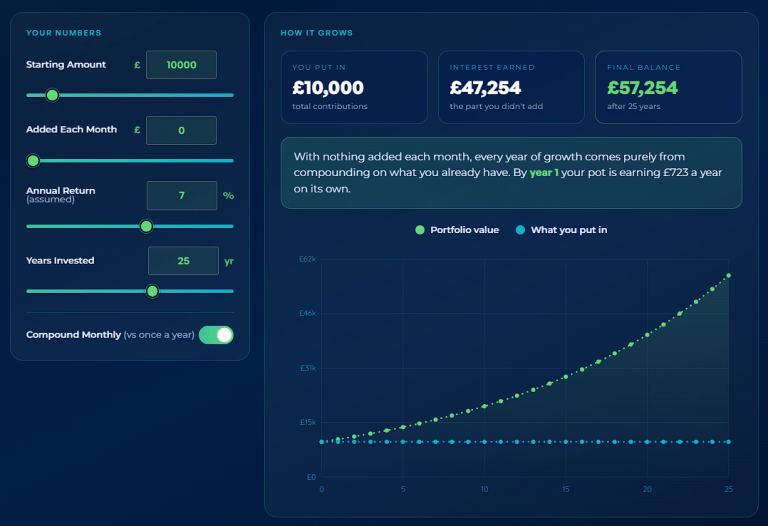
Now skip ahead with no additional contributions, dividends fully reinvested and a return of around 4% a year, in line with the income side of the pie’s style and assuming no help from share prices:
- After 20 years: the £10,000 grows to roughly £22,226, with annual dividend income of about £889 by that point, without you ever adding another penny.
- After 30 years: it’s roughly £33,135, with annual income of about £1,325, depending on dividend growth over the period.
So yes, it works. But look at the timescales. That’s decades of patience for a meaningful outcome, starting from a £10,000 base, which isn’t a small amount to have available up front.
£10,000 Plus £200 a Month: How Much Faster It Grows
Now the same scenario with regular contributions layered on top. Same £10,000 start, same 4%, same reinvestment, but adding £200 a month.
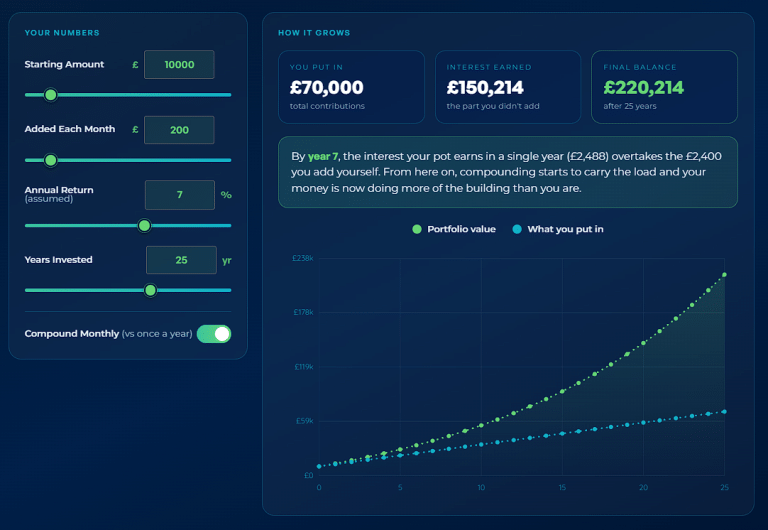
Over 20 years you end up with a pie worth roughly £95,825, producing about £3,833 a year in dividend income.
The gap between the two scenarios isn’t double; it’s more than four times. That’s the power of fresh money on top of compounding, especially in the early and middle years when the existing pie hasn’t grown large enough for reinvestment alone to move the needle.
You can run your own numbers in the compound interest calculator. But this is the direct answer to the question: you can build a dividend pie and never add more money, but for most people, most of the time, adding money is where the real acceleration comes from.
How Inflation Affects a Pie With No New Contributions
One thing makes the pure-reinvestment approach harder than it looks on paper. If you don’t add fresh money, the real purchasing power of your dividend income depends entirely on whether the pie’s dividend growth outpaces inflation.
In high-inflation periods, which we saw a few years ago, a pie receiving no fresh capital can lose ground in real terms even while the nominal income rises.
Dividend growth of 5% a year is fine in a 2% inflation environment and a problem in a 6% one. Fresh contributions are one of the more reliable ways to insulate against that, because you’re buying more shares in an environment where prices and dividends may both be moving up.
When It Makes Sense to Stop Adding Money
There are legitimate reasons to build a pie and then stop adding to it. They’re specific rather than general.
- A one-off sum with no income on top. An inheritance, a business sale, a windfall. Letting the pie compound off its own income is a valid strategy; it’s the only one available in that situation.
- Already in the decumulation phase. Retired or semi-retired, with the pie producing income you’re using. You’re not adding because you no longer need to; the pie is doing its job by paying you, not by growing.
- The pie is deliberately the income part of a wider portfolio. You’re contributing elsewhere, to a growth index fund or a pension. Not adding to this pie doesn’t mean not investing; the money is going where it fits your plan better.
When You Should Keep Contributing
Where I’d push back is when someone in the accumulation phase, still earning, asks whether they can shortcut the process by dropping a lump sum in and walking away. The maths doesn’t support that being the fastest route.
Consistent contributions plus reinvestment is dramatically more powerful than reinvestment alone, and it’s more resilient against inflation, market timing and life circumstances. Every extra pound going in earlier is a pound that compounds for longer.
The urge to “set it and forget it” is understandable, but the forgetting part isn’t the win. Contributing consistently and forgetting about the day-to-day is the win. Those are different things.
Lump Sum, Monthly Contributions or Both? What I’d Do
- A decent lump sum and no ongoing income: I’d still invest it and let it run, because it’s the best available option and the compounding still works, just more slowly.
- A lump sum and ongoing income: I’d invest the lump sum and set up consistent monthly contributions on top. That combination is where the real work gets done. Whether to do that manually or on a schedule is covered in AutoInvest or manual investing.
- A portfolio already at a comfortable size: if I was thinking about pulling back on contributions, I’d think carefully about what the pot is for. If it’s producing the income I need, fine: coast on the reinvestment. If it’s still meant to grow into something larger, keep feeding it.
So, Can You Build a Dividend Pie Without Adding Money?
Yes, technically, and it works over long horizons. But for most people, especially anyone still earning, adding money is where the outcome dramatically improves.
The pie is a compounding machine that responds to how much you feed it; the more you can put in, especially early, the more work the compounding does in the years that follow. If you can add, add. If you can’t, the strategy still works, just more slowly, and you’ll want to be honest with yourself about the timelines.
How the pie is designed to be funded and maintained is on the (Almost) Daily Dividends Portfolio page.