
Updated 30 October 2026
Imagine adding money to a single investment and having it spread automatically across a professionally built, diversified portfolio, with dividends reinvested and the mix kept roughly on target, without you choosing a single stock.
That is the idea behind Model Pies, and it is one of the reasons hands-off investors gravitate to Trading 212.
There is more nuance to how they work than it may seem at first, though, and a couple of things worth understanding before you put money in.
Here is what a Trading 212 Model Pie is, how it differs from the other kinds of Pie, what it costs, and who it suits.

Key Takeaways
- A Pie groups several investments into one portfolio, where each holding, or slice, has a target percentage.
- A Model Pie is a ready-made, diversified portfolio of ETFs designed by professional asset managers like Vanguard, BlackRock and WisdomTree.
- AutoInvest funds it on a schedule and self-balancing keeps it roughly on target, with dividends reinvested automatically.
- There is no platform or management fee, but the underlying ETFs have their own set of charges, plus a potential 0.15% currency fee.
The Short Answer
On Trading 212, a “Pie” is a way of grouping several investments into one portfolio, where each holding (called a “slice”) has a target percentage.
There are three kinds: Custom Pies you build yourself, Social Pies shared by other investors, and Model Pies.
A Model Pie is a ready-made, diversified portfolio built from ETFs and designed by professional asset managers. You add it, optionally set up AutoInvest, and it stays roughly aligned to its target over time.It is important to know that Model Pies on Trading 212 are execution-only: they are not advice, and choosing one and deciding it is right for you remains your responsibility.
For the platform basics, see our guide on how to use Trading 212.
What Is a Pie?
Before focusing on Model Pies, it helps to be clear on Pies in general.
A Pie groups several investments together so that, instead of buying each one separately, you create a set of slices, each with a target percentage. For example, a simple three-slice Pie split evenly would have each slice targeted at roughly 33%.
The point of those targets is that Trading 212 can keep your portfolio as close as possible to them automatically when you add money.
Pies are available on both the Invest account as well as the Stocks and Shares ISA, and a single Pie can hold up to around fifty investments.
This system is powered by AutoInvest: you set a recurring deposit, choose how often it runs, and the money is spread across your slices for you.
All of this relies on fractional shares to hit those exact percentages, which is why a Pie can land on taret allocations rather than being thrown off percentage-wise by the cost of whole shares.
What Makes a Model Pie Different
A Model Pie is a specific, ready-made type.
Instead of picking the holdings yourself, you invest in a ready-made, pre-designed portfolio. Professionals create these portfolios to match a specific risk tolerance and objective and each one provides a diversified mix across asset classes.
The key distinction is who builds them.
Model Pies are created by established third-party asset managers such as Vanguard, WisdomTree and BlackRock. They are not created by Trading 212 themselves or by other users of the platform. That is what separates them from Social Pies shared by everyday investors.
Every Model Pie holds only ETFs. However, those ETFs can contain equities, bonds and commodities underneath. This means a handful of funds can still provide broad diversification.
You can also view the asset allocation and full composition before investing.
They are actively maintained, and the respective managers of the model pies typically update target weights at least quarterly. Trading 212 then notifies you, allowing you to apply or dismiss the changes. If you dismiss them, your portfolio will drift from the manager’s model. That may change the risk and return profile originally intended.
Trading 212 also makes an important point regarding all pies. A Model Pie provides allocation data only. It is not investment advice, a recommendation, or a guarantee of future performance.
The Different Types of Model Pie
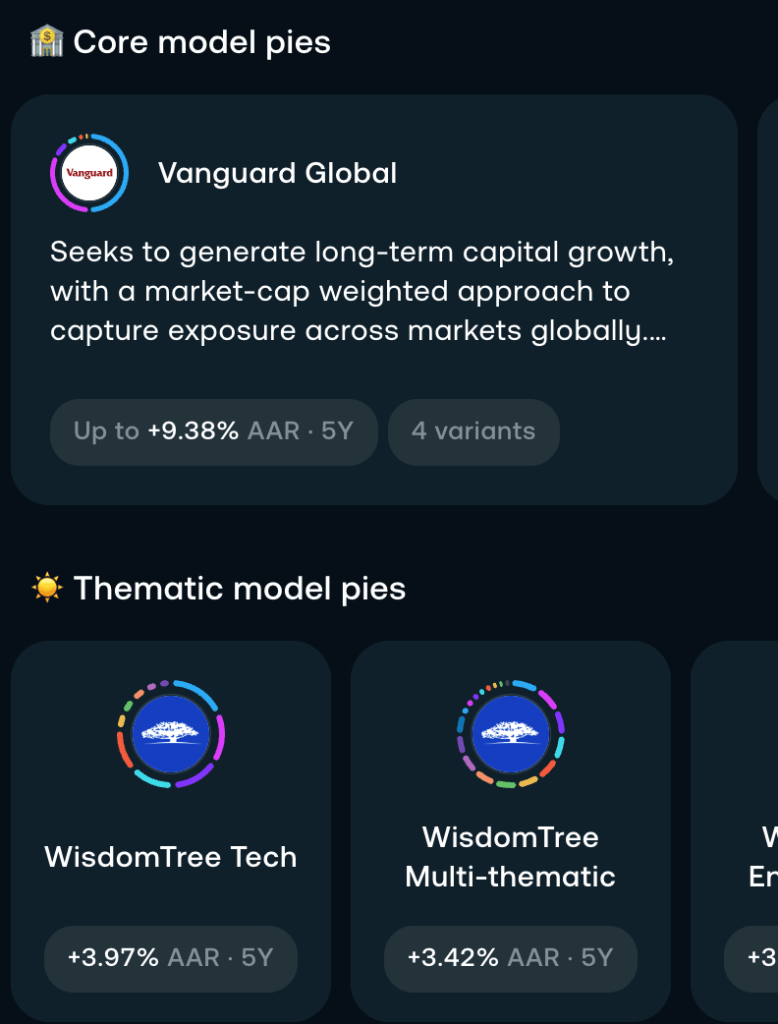
| Type | What it holds | A Short Description |
| Core | Diversified across multiple asset classes | The broadest type. Diversification itself is the goal, with no single unifying theme |
| Multi-thematic | Equities only, several themes bundled together | e.g. Artificial Intelligence, Cloud Computing and Green Energy at once |
| Thematic | Equities only, concentrated on a single theme | e.g. a technology or environmental Pie. This comes with more concentration risk |
They fall into a few categories, which is the part that helps you see whether any of them fit.
- Core models are the broadest, diversified across multiple asset classes, where diversification itself is the goal rather than any theme.
- Multi-thematic models usually hold only equities and bundle several themes at once, such as artificial intelligence, cloud computing, and green energy.
- Thematic models also hold only equities but concentrate on a single theme, such as a technology or an environmental Pie. This brings more concentration risk because you are leaning into one area rather than spreading across many.
The non-thematic models like Core also come in variants that control the split between equities, bonds and commodities.
A conservative variant leans towards lower volatility with more weight in bonds; a moderate variant aims for a balanced middle; and an aggressive variant weights heavily towards equities for maximum growth potential, accepting more ups and downs.
It is essentially the same underlying model, adjusted to how much volatility you are comfortable with.
(Execution only service. Not investment advice or portfolio management)
How Model Pies Work Day to Day
A few of the platform’s mechanics run in the background once you have added and invested in a Model Pie.
AutoInvest schedules recurring deposits, daily, weekly, fortnightly, monthly and so on, funded from your cash balance or a linked card, and you can pause or change it anytime.
New money is allocated in one of two ways: the default is self-balancing, where money goes first to the slices that are below target, so the Pie drifts back towards its intended allocation on its own. The alternative, by targets, simply splits each deposit by the set percentages.
You can also trigger a full rebalance with one tap, but that involves selling the overweight slices. This means that in a taxable Invest account, it can have tax implications, whereas inside an ISA, that is not so much of a concern.
Dividends reinvest automatically once they build past a small threshold, unless you switch that off to take the income as cash instead.
There is also a minimum: every Pie’s minimum investment is set by its smallest slice, because that slice has to be worth at least £1, so if the smallest slice is 4%, the minimum is £1 divided by 0.04, which is £25.
What Do Model Pies Cost?
Trading 212 does not charge a fee for using Pies or AutoInvest. However, “no platform fee” is not necessarily the same as “free.” It is worth understanding where the real costs sit.
Two costs apply.
First, Model Pies are built from ETFs, and those funds carry their own expense ratios. These charges are deducted within the fund by the manager, not by Trading 212.
They are usually a fraction of a percent, but they vary by Pie.
Second, the standard 0.15% currency fee applies when you buy assets priced in another currency. ETFs may be priced in dollars, so if the FX fee is a concern, look out for those funds.
If you fund AutoInvest by card, the card deposit fee also applies. This happens once you have deposited more than £2,000 in total.
None of this makes Model Pies expensive as such. Built from low-cost ETFs, they often work out cheaper than a traditional managed fund, and cheaper than a bank’s ready-made ISA that stacks a platform or advice fee on top of the fund costs.
The point is simply to know the fund-level charges exist rather than assuming the whole thing is completely free; our guide to Trading 212 fees covers the platform side.
Are Model Pies Right for You?
Model Pies suit a particular investor well: if you want a hands-off, diversified, set-and-forget approach, you pick a Pie, set up AutoInvest, and let it run. They are hard to beat for convenience, especially if you are newer and do not yet feel confident assembling a portfolio yourself.
You would lean towards a Custom Pie instead if you want full control over exactly what you hold, which often matters for a dividend-focused investor who wants specific income payers rather than a generic growth allocation, and you can reorganise holdings between Pies using import and export from a Pie without selling.
Social Pies can be a source of ideas, but they are built by individuals, not professionals, and are not vetted as advice, so they warrant extra scrutiny.
Whichever route you take, look at what is actually inside the Pie, understand the underlying holdings and their costs, and make sure it lines up with your goals.
Note also that Pie orders execute in regular hours only, so 24/5 trading does not apply to them.
Conclusion
Model Pies are ready-made, diversified ETF portfolios designed by professionals. They are funded automatically through AutoInvest and kept roughly on target through self-balancing. The costs are low, but not zero.
They remove the work of building a portfolio, but not the responsibility of choosing the right one, so treat the “designed by professionals” label as a starting point for your own research, not a reason to skip it.
For a lot of people, they are one of the simplest ways to invest consistently.
FAQ
What is a Model Pie on Trading 212?
A ready-made, diversified portfolio of ETFs designed by professional asset managers, which you can add to your account and fund automatically with AutoInvest.
Are Model Pies free?
There is no platform or management fee, but the underlying ETFs have their own ongoing charges, and the 0.15% currency fee applies to non-GBP holdings. (Other fees may apply)
Who builds Model Pies?
Established third-party asset managers like Vanguard, BlackRock and WisdomTree, not Trading 212. Social Pies, by contrast, are built by other users on the Trading 212 platform.
Are Model Pies financial advice?
No. Trading 212 states they provide allocation data only. They are execution-only, and you are responsible for deciding whether one fits your goals.