
Updated 27 October 2026
Short answer: Use Self-Balancing while your deposits are large relative to the pie, because each deposit then does real rebalancing work. Once the pie is big enough that deposits no longer move the allocations, switch to By Targets and rebalance manually every so often.
Custom is mostly for people overthinking it. It’s a deposit-screen setting, not a permanent choice, so you can switch at any time.
When you deposit into a Trading 212 pie, the platform asks how you want that money distributed across the holdings. There are three options:
- Self-Balancing
- By Targets
- Custom
The choice affects how your pie behaves over time, especially as it grows. Here’s what each one does, when each fits, and the practical framework I use.
Self-Balancing on Trading 212: How It Works
Self-Balancing is the default, and it does what the name suggests. When you deposit, Trading 212 compares your current allocation with your target weightings and directs the new money towards the slices that are currently underweight, bringing the pie gradually back in line using new deposits.
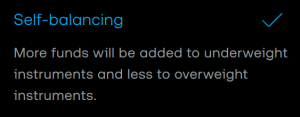
A quick example using the pie itself. Say the (Almost) Daily Dividends pie is meant to sit at roughly 2% per slice across 50 holdings. Over a good year some slices run harder than others: a handful drift up to around 3%, a handful down to around 1.5%. Deposit £100 with Self-Balancing on and most of it goes to the 1.5% slices to bring them back towards 2%, while the 3% slices get little or nothing.
The critical point is that Self-Balancing doesn’t sell overweight slices. It only uses new money to top up underweight ones. So it’s a passive form of rebalancing that works only to the extent that your deposits are large enough to move the needle.

By Targets on Trading 212: How It Works
By Targets does something completely different. When you deposit, Trading 212 splits the money strictly according to the target percentages you set for the pie, ignoring how the actual weightings have drifted.

Using the same drifted pie, deposit £100 with By Targets and £2 goes into each of the 50 holdings regardless of whether they’re over or underweight.
The deposit doesn’t correct anything; it adds new money in the original planned proportions, so the drift stays exactly where it was.
By Targets keeps incoming money aligned with the plan but does nothing about existing drift. To actually rebalance a drifted pie under this mode you do it manually, either with the Rebalance button or with custom deposits into the underweight slices. Manual rebalancing is covered in do I need to rebalance the pie?
Custom Allocation on Trading 212
Custom lets you decide, for that specific deposit, how much money goes into each slice using sliders. It’s essentially switching off the pie’s automation for one transaction.

In most cases, this isn’t particularly useful. If you find yourself wanting custom allocations regularly, you’re fighting the point of having a pie. Pies are designed to distribute money by rules, either your targets or the balancing logic. If you want fully hands-on allocation on every deposit, buying the underlying stocks individually outside the pie would be simpler.
Custom exists for the occasional intentional deviation, topping up one slice more heavily during a specific opportunity, for instance, but it isn’t where you want to be for regular use.
Self-Balancing or By Targets: Which Should You Pick?
For most people copying the (Almost) Daily Dividends pie, the answer changes as the pie grows. There’s an early-stage answer and a later-stage answer, and knowing when to switch is the useful part.
Early On: Use Self-Balancing
While the pie is still relatively small, Self-Balancing is almost always the right choice, because of proportion. Early on each deposit is a large percentage of the whole pie, so it can actually move the allocations.
Say you start with £400 and add £100 a month. That first £100 is a 25% increase in your total pie. Directing all of it at the underweight slices has a very real effect on the balance. As long as deposits are big relative to the pie, Self-Balancing keeps the allocations tight against target without you intervening, which is exactly what it was designed for.
When to Switch to By Targets
As the pie grows, the same £100 becomes a smaller and smaller share of the total. Follow the example forward: after three years of £100 a month on top of the £400 start, the pie might be worth around £4,000, and £100 is now only 2.5% of it. That’s not enough to meaningfully correct drift anymore.
At that point Self-Balancing is still directing deposits at the underweight slices, but they’re too small to bring the pie back into balance, and drift accumulates month after month. This is where switching to By Targets makes more sense: there’s no benefit to running Self-Balancing once deposits can’t rebalance on their own, and By Targets gives a cleaner picture of how new money is distributed relative to the plan.
You then handle rebalancing manually and occasionally, perhaps once a year or when the pie score drops to around 6.5 or below, which is my usual signal.
Suggested Approach for the (Almost) Daily Dividends Pie
- Start with Self-Balancing from day one and let it do its thing for a good while, without overthinking it.
- Switch to By Targets once you notice deposits aren’t keeping up with drift, which usually shows up as the pie score not improving after deposits the way it used to.
- Rebalance manually when the score gets uncomfortable.
There’s no exact figure at which to switch. It’s a “when the deposits stop making a difference, change gears” trigger. For most people, that’s somewhere in the low thousands to ten-thousand range of pie size, depending on how much they deposit each month.
Does Trading 212 AutoInvest Use Self-Balancing or By Targets?
Both are available. Trading 212’s AutoInvest defaults to Self-Balancing, the same as manual deposits, and you can switch it to By Targets in the AutoInvest settings at any time, before or after setting it up.
So the same early-stage/later-stage logic applies whether you deposit by hand or on a schedule. The two funding methods are compared in AutoInvest or manual investing.
Can I Switch Between Them?
Yes, at any time. It isn’t baked into your pie; it’s a setting on the deposit screen. You can pick Self-Balancing for one deposit and By Targets for the next.
Self-Balancing vs By Targets: Quick Recap
- Self-Balancing while your deposits are big relative to the pie.
- By Targets once they aren’t.
- Custom mostly for people who are overthinking it.
The right choice isn’t one option forever; it’s a setting that should evolve as the pie grows. Keep an eye on the pie score and on how much impact your deposits actually have against the total, and switch when it makes sense.
The wider approach to funding and maintaining the pie is on the (Almost) Daily Dividends Portfolio page.
Pies & AutoInvest is an execution-only service, following your own investment decisions. Not investment advice or portfolio management. You are responsible for all investment and rebalancing decisions.