
Updated 20 October 2026
On the differences between AutoInvest and manual investing on Trading 212 Pies, and which approach suits your investing goals.
Short answer: AutoInvest and manual investing do the same thing mechanically. Both invest into the same pie, both use the same distribution options, both cost the same. The difference is who pulls the trigger and how often.
AutoInvest suits steady incomes and people prone to overthinking; manual suits irregular incomes and people who want to be involved; and for many people a hybrid of the two is the right answer.
Trading 212 gives you two ways to put money into a pie regularly. They sound more different than they are, but the way you interact with them differs enough that the choice matters for some people.
Most of the confusion comes from not knowing exactly how each works, so I’ll cover the mechanics first; once you understand them, the right choice for your situation tends to fall out naturally.

How AutoInvest Works, Step by Step
AutoInvest is Trading 212’s scheduling system for pies. You configure it once and it runs in the background until you tell it otherwise.
Pies & AutoInvest is an execution-only service, following your own investment decisions. Not investment advice or portfolio management.
To set it up, open the pie and tap into the AutoInvest section. You pick the amount, the frequency and the start date. Frequencies run from daily through weekly and fortnightly to monthly; for weekly and fortnightly you choose the day of the week, for monthly the day of the month.
There’s no real upper or lower limit on the amount beyond the platform’s normal pie minimums.
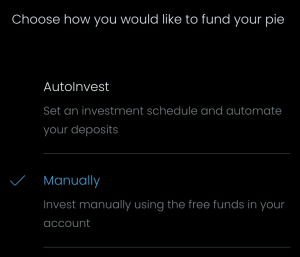
On each scheduled date the deposit is invested into the pie according to the distribution type you’ve chosen: Self-Balancing by default, which tops up underweight slices first, or By Targets if you switch it. Those options are explained in self-balancing vs by targets.
How AutoInvest Is Funded
You choose where the money comes from. If AutoInvest is set to use free funds only, Trading 212 checks the uninvested cash in your account on the scheduled date. If there’s enough, it invests it.
If there isn’t, the deposit simply doesn’t execute: it doesn’t go into debt, doesn’t partial-fill and doesn’t move money from anywhere else.
It skips that cycle and tries again the next one, so you need to keep the account topped up, either with a recurring bank transfer landing a day or two before the AutoInvest date or by holding a cash buffer.
UK accounts can alternatively fund AutoInvest directly from an external payment method such as a linked bank account, with a “Use my cash first” option that tries your free cash before charging the external method.
Note that card and e-wallet deposits above £2,000 cumulative attract a 0.7% fee, so bank transfer is the usual choice.
Beyond setup, AutoInvest doesn’t need touching. You can pause it, change the amount, frequency or day, or switch it off at any time from the app. No commitment, no cancellation period, no penalty; it’s automation on the platform, not a contract.
How Manual Investing Works, Step by Step
Manual investing is the hands-on equivalent: you deposit into the pie yourself, on your own schedule, whenever you decide to.
Open the pie, tap Invest, enter the amount and confirm. With Self-Balancing selected, Trading 212 distributes the deposit across the holdings using the same logic AutoInvest uses. There’s no difference in how the money lands; only in how the trigger gets pulled.
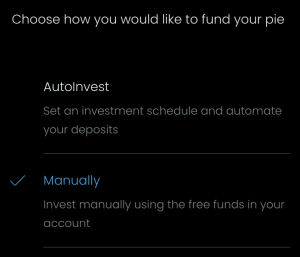
You also have the option of investing a specific amount into a specific slice, which skips self-balancing for that deposit. That’s useful if you’re deliberately nudging one slice up, but it isn’t what most people do day to day.
The money has to be sitting in your account before you can deploy it, same as AutoInvest. But there’s no schedule, no recurring anything, no reminders.
The platform isn’t doing anything in the background; the decision lives with you every single time. That’s both the appeal and the catch of manual investing.
Where the Two Are Identical
Both are free: no fees per deposit, per investment or per trade on Trading 212 pies, though other charges may apply depending on what you’re investing in, such as the 0.15% FX fee on non-GBP holdings, which applies the same way to both.
Both work identically in ISAs and general investment accounts. The mechanics of buying the underlying shares, fractional shares, execution during market hours and so on, are identical too.
So the question isn’t “which is better for investing”. The investing part is the same. The question is which one fits how you want to interact with the strategy.
When AutoInvest Tends to Fit Better
AutoInvest works well for people whose financial life is predictable enough that a fixed recurring deposit won’t cause problems. Salary on the 28th, bills out by the 5th, comfortable surplus by the 10th: set AutoInvest for the 10th and it runs by itself.
It also suits people whose biggest risk is inconsistency rather than poor stock selection. If you know you’re prone to overthinking, skipping months when the news is uncertain, or forgetting to deposit when life gets busy, AutoInvest removes those failure modes by making the decision once, in advance.
And it’s particularly useful in difficult markets. When prices are falling and the news is gloomy, AutoInvest carries on buying more shares at lower prices, exactly when most people emotionally want to stop.
That’s less a clever feature than a psychological advantage: out of sight, out of mind.
When Manual Investing Tends to Fit Better
Manual suits people whose income or surplus is irregular: self-employed, freelance, contract work, commission-based pay, seasonal businesses. A fixed monthly AutoInvest can force you to invest in a month you can’t realistically spare it, which isn’t sustainable. Manual lets you set the deposit to what came in.
It also suits people who want to be engaged with the strategy, who enjoy looking at the pie, choosing deposits and topping up when there’s extra cash. It just depends on your discipline to keep the habit going rather than the platform keeping it going for you.
And if you specifically want opportunistic top-ups, during market wobbles, after a bonus, when a windfall lands, manual gives you that flexibility. AutoInvest doesn’t react to anything; it executes the schedule you set.
The Hybrid Approach
For a lot of people the right answer is a combination. Run a base AutoInvest at a level you can comfortably sustain through your tighter months, even if it’s relatively small. That guarantees the strategy keeps going regardless of what else is happening.
Then make manual top-ups whenever there’s extra cash: a bonus, a tax refund, a month where outgoings were lower.
You get the consistency baseline from AutoInvest without losing the flexibility to act when you want to add more. The two aren’t in competition; they work together if you set them up that way.
Pausing AutoInvest During Downturns
Some people set up AutoInvest, then during a market downturn feel uncomfortable about deposits going in while prices fall, and want to pause it. I’d encourage you to think very carefully before doing that.
Falling markets are precisely when AutoInvest is doing the work you set it up to do: buying more shares at lower prices. Pausing during a crash is, in practice, very similar to panic-selling: an emotional response to falling prices, expressed slightly differently.
If you set up AutoInvest, set it up with the intention of leaving it alone, especially in the moments you most feel like stopping it. The wider timing question is covered in should you wait for a market dip?
So Which One Should You Pick?
It’s case by case rather than a universal answer.
- Steady income and prone to overthinking: AutoInvest.
- Variable income or you want active involvement: manual.
- Somewhere in the middle, or you want the safety net of automation without losing flexibility: hybrid.
None of those is the “correct” answer. They’re three different ways, and the right one depends on how you actually behave in practice, not how you’d ideally like to behave. Be honest with yourself about that when you set it up.
Conclusion
AutoInvest and manual investing on Trading 212 do the same thing mechanically: same distribution logic, same pie, same cost. The difference is who pulls the trigger and how often.
Pick the setup that fits your real financial life, not the one that sounds best in theory, and whichever you pick, give it long enough to work. The strategy is the bit that matters; the cadence is just how you execute it.
For the (Almost) Daily Dividends pie specifically, the funding approach I use and why is on the portfolio page, and the mechanics of setting up a pie are in how to create a Pie on Trading 212.
The content on this page is intended for information and educational purposes only and should not be considered investment advice or investment recommendations. When investing, your capital is at risk, and you may get back less than invested. Past performance does not guarantee future results.