
Updated 26 October 2026
Short answer: Auto-reinvest is on by default in a Trading 212 pie. Dividends land in Pie Cash and are reinvested either:
- When Pie Cash crosses a threshold (£1 divided by your smallest slice weighting), or
- When your next deposit sweeps them in.
If your dividends “aren’t reinvesting”, you almost certainly haven’t hit that threshold yet, and that’s normal.
This question comes up in three different forms, and they’re really one topic: how does reinvestment actually work in a pie, why aren’t my dividends reinvesting even though they’ve arrived, and should I reinvest at all or take the income?
The first two are mechanics; the third is strategy. I’ll cover the mechanics first, because the strategy question doesn’t make sense until you know what’s happening under the hood.
Is Dividend Reinvestment On by Default in a Trading 212 Pie?
Yes. Dividend reinvestment on Trading 212 pies is turned on by default. If you copied the (Almost) Daily Dividends pie and haven’t changed any settings, your dividends are set to reinvest. Whether the actual reinvestment has happened yet is a separate question we’ll get to.
To check or change the setting:
- Open the pie.
- Tap into the Dividends section.
- Use the cogwheel icon in the top-right corner. That’s where the Auto Reinvest toggle lives.
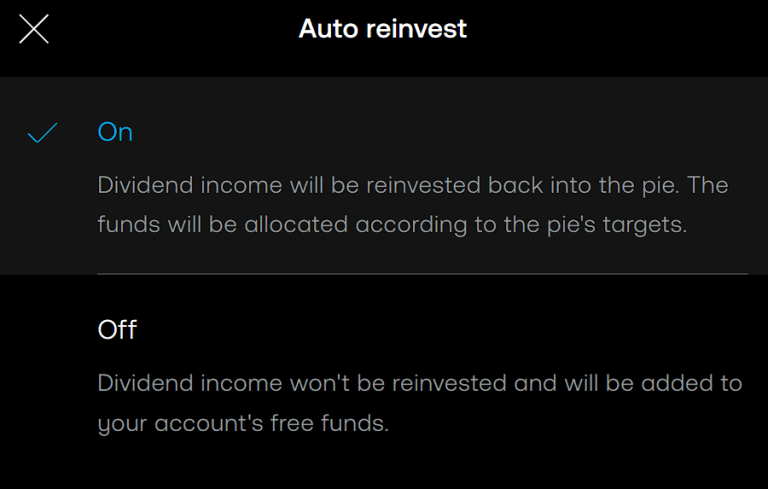
- On: dividends stay inside the pie and get reinvested.
- Off: they flow out of the pie into your general free cash, where they sit as ordinary cash you can withdraw or use elsewhere.

How Dividend Reinvestment Works in a Trading 212 Pie
When a stock in your pie pays a dividend, the cash goes into what Trading 212 calls Pie Cash, a small cash balance that sits inside the pie itself.
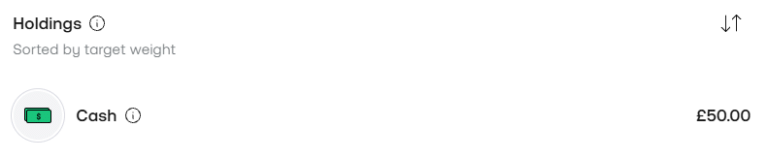
That Pie Cash isn’t reinvested immediately. It waits, and two things can trigger the reinvestment:
- Crossing the threshold. Once Pie Cash exceeds a specific amount, the platform deploys it back into the pie automatically, distributed using self-balancing logic so the underweight slices are topped up first.
- Your next deposit. When you invest new money into the pie, manually or via AutoInvest, any Pie Cash from dividends is bundled in with the deposit and invested together. If you have £1.86 in Pie Cash and deposit £200, £201.86 goes in that day.
That second trigger is why people who deposit regularly rarely see Pie Cash build up: every deposit sweeps whatever has accumulated back into the pie.
Why Aren’t My Dividends Reinvesting Yet? The Threshold Explained
This is the version of the question I get most, and the answer is nearly always that you haven’t hit the threshold.
The threshold isn’t a fixed number. It’s £1 divided by the smallest slice weighting in your pie, expressed as a decimal. It’s tied to the smallest slice because Trading 212’s minimum order is £1 per stock, so to reinvest across the whole pie there has to be enough cash for every stock to receive at least £1.
Two examples:
- Smallest slice weighted at 0.5% → £1 ÷ 0.005 = £200 before automatic reinvestment kicks in.
- Smallest slice weighted at 2% → £1 ÷ 0.02 = £50. A pie with roughly even weightings across 50 holdings sits around here.
For the (Almost) Daily Dividends pie the exact threshold depends on the current weightings, which shift slightly over time. You can see the live figure in the app: go to Holdings, tap Edit Pie, and look at Min Investment. That number is your reinvestment threshold.
Reinvestment in a Small or New Pie
If your pie is new or small, your dividends are almost certainly landing in Pie Cash and waiting because they haven’t added up to the threshold yet. This is normal, it isn’t a bug, and there’s nothing to fix.
- If you deposit regularly, say monthly, that Pie Cash gets swept into your next contribution automatically, so the practical effect is basically zero: your dividends are reinvested on the day of your next deposit rather than the day they arrive.
- If you aren’t depositing regularly and Pie Cash is accumulating on its own, you’ll wait until it hits the threshold and then reinvestment happens in one go. On a small pie that could take a few months. Again, it’s working as designed.
And while it waits, Pie Cash earns interest if you have interest on uninvested cash enabled.
Reinvestment in a Larger Pie
As the pie grows and dividend income scales up, the threshold matters less. A pie producing several hundred pounds a month in dividends hits the threshold quickly and often, so you’ll see regular automatic reinvestment events without your deposits needing to trigger them.
This is one of those quiet compounding effects that only shows up once you’ve been at it for a while. Early on, dividends are small enough that they mostly get swept up in monthly contributions. Later, the dividends alone are doing meaningful reinvestment work in the background.
Should You Reinvest Dividends or Take the Income?
Now the strategy question. It depends on what stage of investing you’re in and what you’re building the pie for.
The Case for Reinvesting Dividends
If you’re in the accumulation phase, still growing the pie towards an eventual income goal rather than living off it, reinvesting is the stronger choice for compounding. Every dividend you reinvest buys more shares, which produce more dividends, which buy more shares.
Total return studies consistently show that a large chunk of long-run stock market returns comes specifically from reinvested dividends. There’s a practical point too: if you’re still earning from work, taking dividends out gives you money you probably don’t need yet, which is the least productive use of it.
The Case for Taking the Income
Where it flips is when the pie is actually paying for something in your life. If the income now covers bills, funds your lifestyle or supplements your salary, that’s the whole point of having built it. Taking the dividends out isn’t abandoning the strategy; it’s the strategy doing its job.
Some people sit in between: taking dividends out to fund a different portfolio, or to cover specific recurring costs so the pie becomes a dedicated bill-payer. Those all work; they’re just different applications of the same income.
Switching isn’t irreversible. You can toggle between reinvest and take-out as your situation changes. Starting with reinvest on, then flipping it off when you’re ready to live on the income, is a normal progression.
Reinvest or Take the Income: What I’d Do
For most people reading this: reinvest. If you’re still working, still contributing, and the pie is nowhere near replacing a chunk of your income, keep auto-reinvest on and let the compounding work. Individually the dividends aren’t worth much to you right now; as compounded pie shares they’re worth a lot to your future self.
If you’ve reached the point where the pie is producing income you want to use, flip it off, let the dividends land in free cash, and enjoy what you built.
The wider maths of compounding, with and without fresh contributions, is worked through in can you build a dividend pie and never add more money? And if the question is really “why haven’t any dividends arrived at all?”, that’s a different issue covered in why haven’t my dividends arrived yet?
Trading 212 Dividend Reinvestment: Quick Recap
- Auto-reinvest is on by default.
- Dividends land in Pie Cash and reinvest either when you cross the threshold, £1 divided by your smallest slice weighting, or when your next deposit sweeps them in. If yours aren’t reinvesting yet, that’s almost certainly the threshold.
- Whether to reinvest at all depends on whether you’re building the pie or living off it: reinvest while building, switch to income when the pie is ready to pay you.
- Check the Min Investment figure in the app if you want to know exactly where your threshold sits.
For the full picture of the pie itself, see the (Almost) Daily Dividends Portfolio.